
Original research from ReputationStacker
A customer complains about an invoice. Support explains the charge. Everyone moves on.
Then another customer complains about the same invoice. And another.
At some point, someone ought to tell the person who designed the invoice. That’s where a lot of customer feedback programs fall apart: the complaints get handled, but the underlying problem survives.
In ReputationStacker’s 2026 survey, 61% of respondents reported making at least one documented operational change because of customer feedback in the preceding year. But 46% said they don’t measure whether those changes improved customer satisfaction. So businesses are making changes. Whether the changes worked is often another question entirely.
Key findings: customer feedback and sentiment analysis
- 45% said they read reviews individually without formal trend analysis; 12% use AI-powered review analysis.
- 73% track service quality in customer feedback, 68% track staff friendliness or professionalism, and 66% track communication.
- 34% said recurring negative feedback is discussed internally, but action isn’t always taken.
- 61% reported at least one documented operational change driven by feedback during the previous year.
- 46% don’t measure whether those changes improve customer satisfaction; only 13% said they measure results systematically.
Businesses are collecting feedback from plenty of places
Reviews get the attention because they’re public. But customers also complain by email, contact support, fill out surveys, and tell staff what went wrong.
In the survey, 57% reported using post-service surveys, 52% customer-support interactions, 51% customer emails or complaints, and 47% social messages. Respondents could select multiple sources.
Think of a business getting three complaints about the same confusing charge: one in Google, one in support, and one in a survey. If each goes to a different department, it’s three isolated incidents. To the customer, it’s the same unresolved problem happening repeatedly.
Service quality, staff, and communication dominate feedback analysis
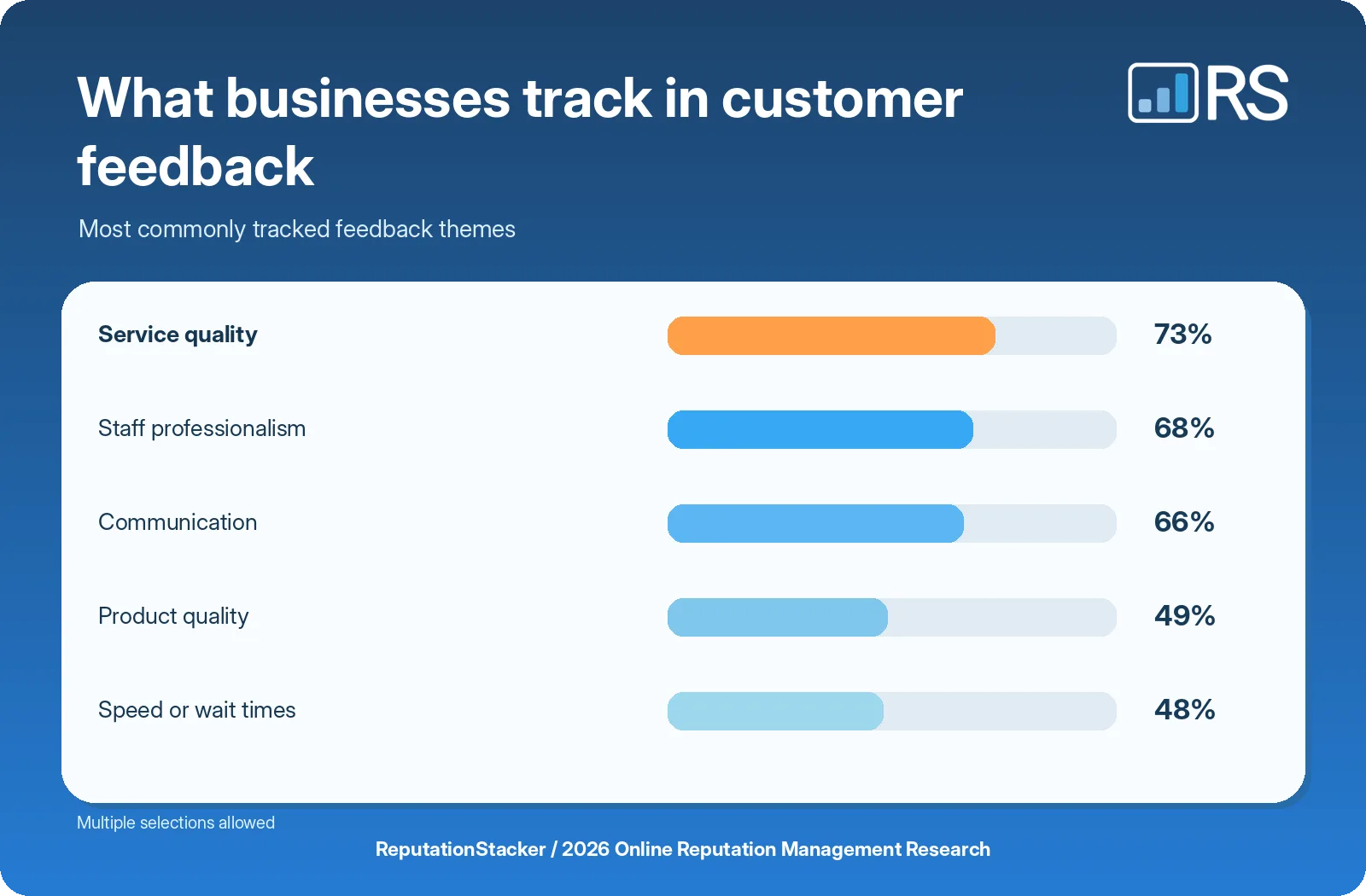
Service quality (73%), staff friendliness or professionalism (68%), and communication (66%) were the most commonly tracked topics. They’re also the everyday things that tend to bring customers back—or send them elsewhere.
Even with those issues in mind, 45% still read written reviews individually without formal trend analysis, while 21% use software reporting and 12% use AI-powered analysis.
At a single location receiving a few reviews each week, a manager may have a pretty good feel for what’s happening. Once the reviews span multiple platforms or dozens of branches, that confidence can become misleading. Nobody remembers every complaint, and the ones that stick in your memory aren’t necessarily the ones occurring most often.
AI Review Insights helps managers look for common patterns and investigate them in more detail. Customer Feedback captures information that may never appear in a public review.
Sentiment analysis reveals which parts of the customer experience are slipping
Sentiment analysis is useful when it helps identify which part of the customer experience is getting better or worse.
Imagine that the reviews for a dental practice are mostly positive. Patients praise the dentist and staff. At the same time, more reviews begin complaining about scheduling. The business doesn’t need to be told that its overall sentiment is positive. It needs to know that scheduling is becoming an issue before patients start choosing another practice.
ReputationStacker’s Review Sentiment Analysis and customer sentiment solution help businesses examine the substance of those comments. The point is to identify something specific enough that a manager can investigate it.
What happens when customers keep reporting the same problem?
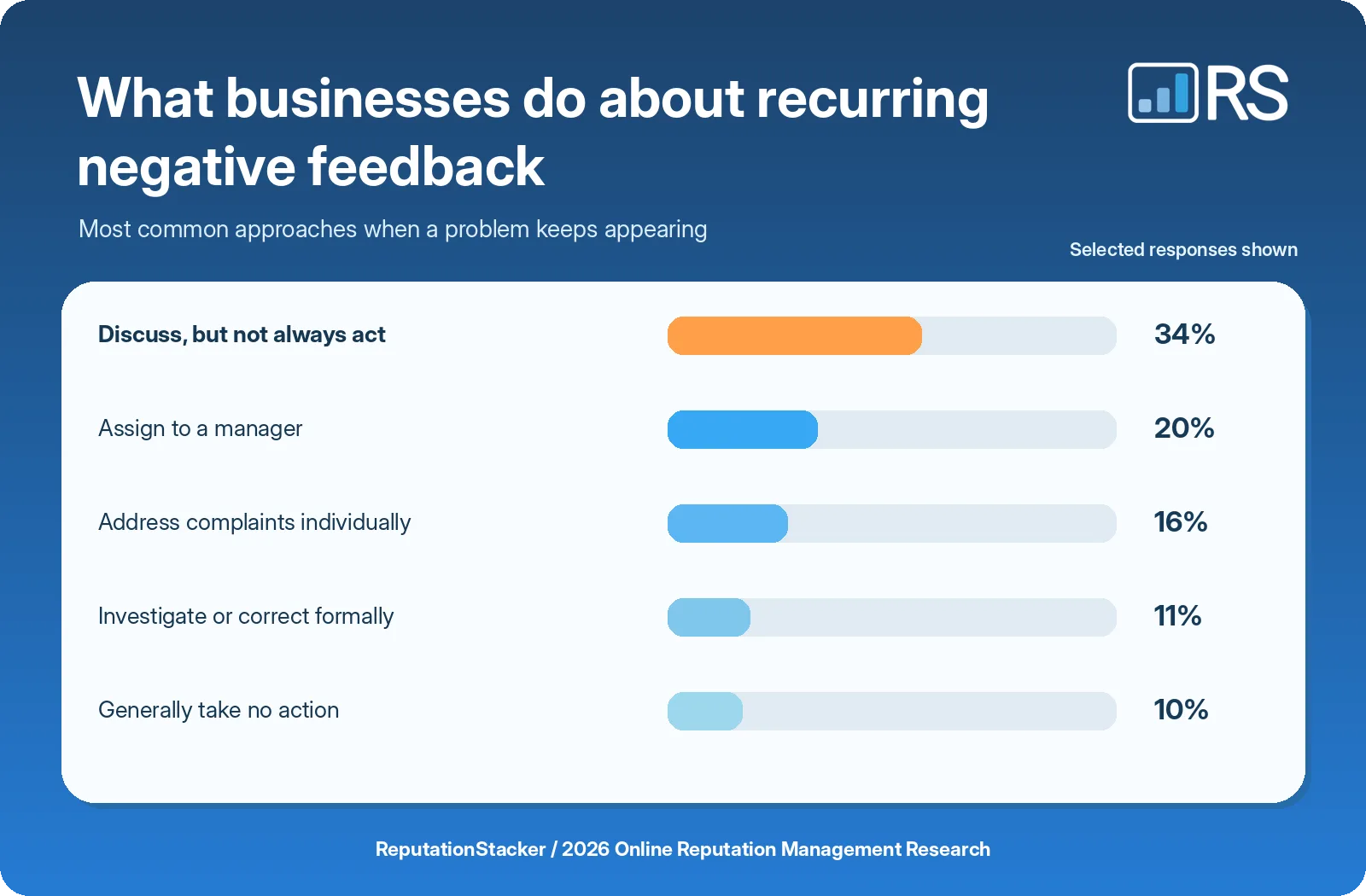
The most common response to recurring complaints was discussion without consistent follow-up: 34% said the problem is discussed internally but action isn’t always taken. 20% assign the issue to a manager. 16% address individual complaints without checking the wider pattern. 11% reported a formal investigation or corrective action, while 10% generally take no action.
The distinction between discussing a problem and assigning it to someone matters. A recurring billing complaint can be handled politely by support again and again, while the person who could simplify the invoice never hears about it.
In that situation, asking staff to write nicer apologies isn’t much of a solution.
Customer feedback is already leading to changes
61% reported making at least one documented operational change because of customer feedback during the preceding year. Among respondents answering the follow-up question, employee training (70%), internal-process changes (58%), and customer communication (58%) were common areas of improvement. Multiple selections were allowed.
Some of these fixes are straightforward. Customers say the appointment reminder is confusing, so the business rewrites it. They complain that nobody follows up after a service call, so somebody is assigned to do it. The hard part is making sure the people who can fix the issue see the pattern.
Our respondents also said reviews had exposed an operational problem ahead of internal reporting (43%) or identified a staff-training issue (48%). A healthy overall star rating can still conceal a repeated service or staffing complaint.
The AI reputation management report looks at how companies are using AI to investigate reviews and feedback.
Nearly half don’t measure whether feedback-driven changes work
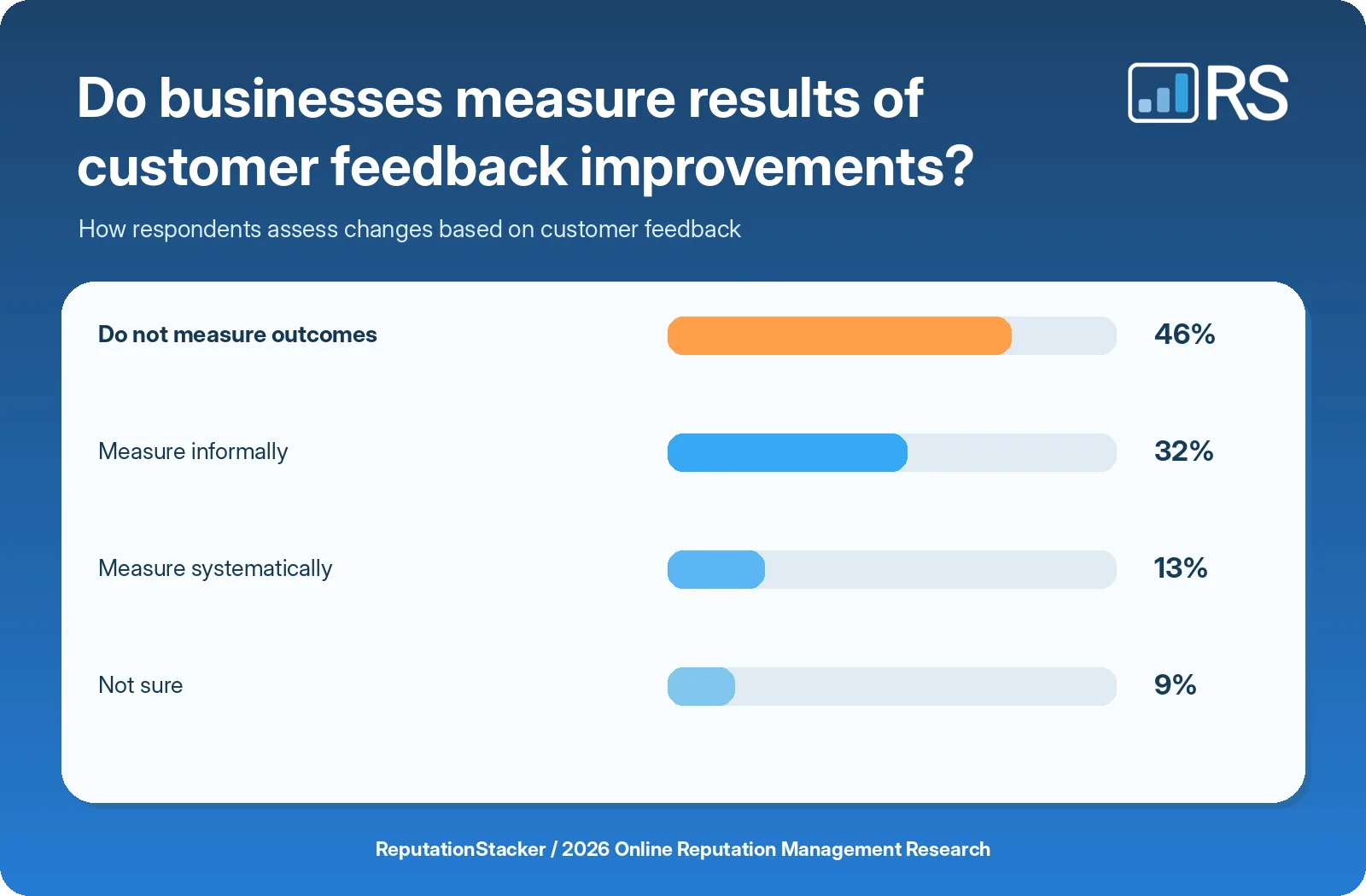
Here’s the awkward part: 46% don’t measure whether changes prompted by feedback improved customer satisfaction. Another 32% check informally; 13% reported systematic measurement.
Suppose a service company changes its scheduling process after complaints about missed appointment windows. The internal rollout goes smoothly. But two months later customers are still reporting the same problem. The change was made; the problem wasn’t solved.
Management doesn’t need a complicated research project to notice that. It needs a habit of looking for the original complaint after the supposed fix.
Making customer feedback more useful
A useful feedback program should be able to tell management which complaints are increasing, where they’re coming from, and whether someone has taken responsibility for them.
That’s harder than counting positive and negative reviews. It usually involves collecting feedback from more than one source and making it possible to examine the comments behind a trend.
ReputationStacker combines Customer Feedback, Review Sentiment Analysis, Location Review Analytics, and AI Review Insights. For businesses focused on the experience across the full customer relationship, its Customer Experience solution provides another useful starting point.
Conclusion: The same complaints shouldn’t surprise you every month
Businesses generally don’t lack feedback. They lack a reliable way to recognize when separate complaints are describing the same problem—and sometimes they lack anyone responsible for making the change.
That’s why the 46% finding deserves attention. Responding to feedback is a good start. Checking whether the underlying complaint disappears is how a business learns whether it actually improved anything.
ReputationStacker helps bring those comments together, find the recurring themes, and give managers a practical way to investigate them. Customers have already done the work of telling businesses what frustrated them. There’s no good reason to keep rediscovering the same problem.
Related ReputationStacker research
- 2026 State of Online Reputation Management & Customer Experience
- AI in Reputation Management: 2026 Research & Trends
- Multi-Location Reputation Management: 2026 Research & Trends
About the research
This ReputationStacker 2026 study includes 419 survey records, including partial responses, from business owners, managers, and others involved in online reputation management and customer experience. Respondents included current and former ReputationStacker users and other businesses. Percentages reflect those who answered each question. Results are self-reported and do not represent all businesses.
