
Original research from ReputationStacker
Managing reviews for one business location is relatively straightforward. Someone can monitor new comments, reply to customers, and speak with the team when a problem comes up.
Add ten more locations and things change. Every branch has different employees, customers, and managers. A complaint that looks isolated at one branch might be happening at five others. Meanwhile, the location with the highest rating may have started slipping months ago, without anyone at headquarters noticing.
ReputationStacker’s 2026 research asked multi-location businesses how they divide responsibility, compare branches, and use customer feedback. One finding stood out: only 27% of respondents to our location-comparison question use automated centralized dashboards. Another 30% rely on informal comparisons, 25% use manual reports or spreadsheets, and 15% don’t compare locations.
Key findings: managing reviews across multiple locations
- 35% share review-management responsibilities between corporate and local teams; 30% use a centralized corporate team.
- 27% use automated dashboards to compare location review performance, while 30% rely on informal comparisons.
- 19% cited identifying underperforming locations as their single biggest challenge; another 19% cited consistent review requests across branches.
- 53% reported using customer feedback to identify underperforming locations at least occasionally.
- 60% said feedback at one location had led to changes at another location at least once.
- 20% use customer feedback as a formal metric when evaluating location managers.
Managing online reviews is a shared job at many companies
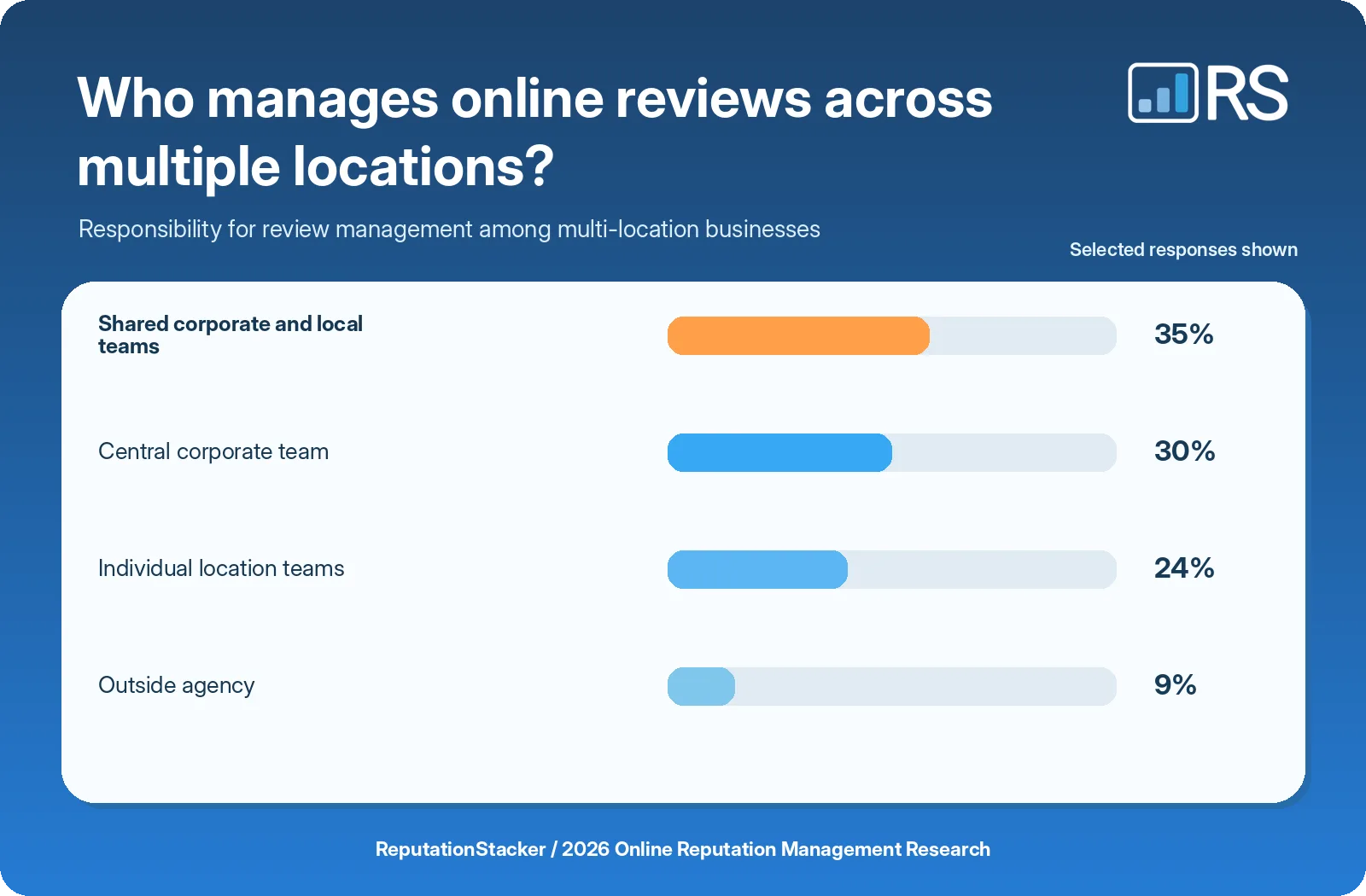
35% said headquarters and locations share responsibility for online reviews. 30% use a centralized team, 24% leave responsibility with location teams, and 9% use an agency.
There’s a good reason responsibility is split. Someone at headquarters can set standards and see patterns across the business. A branch manager knows what happened when a customer complains that the front desk was understaffed on Saturday.
A sensible system gives both people a role. You don’t want corporate publishing an explanation it guessed at, and you don’t want every location inventing its own rules for handling serious complaints.
Most businesses don’t have centralized comparison dashboards
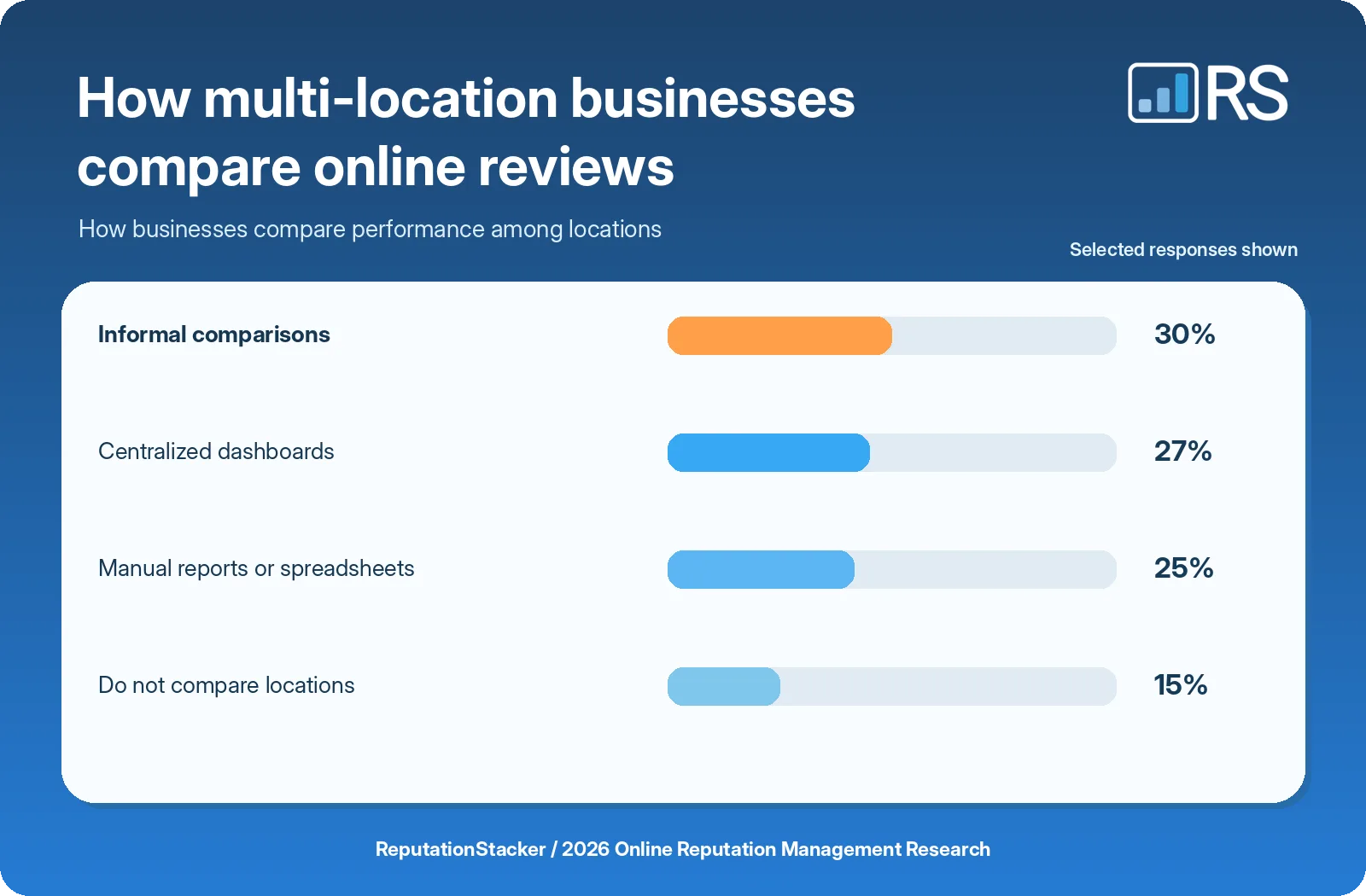
Only 27% use automated centralized dashboards to compare review performance across locations. 30% compare informally, 25% use manual reports or spreadsheets, and 15% don’t compare locations.
For a few branches, a spreadsheet may be good enough. For a large network, someone has to spend an awful lot of time turning separate review feeds into a report—and the report can be out of date by the time anyone reads it.
A companywide average isn’t much help either. Two branches might have the same rating, even though one is improving and the other has collected a growing number of complaints about scheduling. Those are very different management problems.
Location Review Analytics lets ReputationStacker users compare branch-level review performance rather than guessing from a companywide number.
19% say finding underperforming locations is their biggest review-management challenge
When asked for their single biggest review-management challenge, 19% selected identifying underperforming locations and another 19% chose getting locations to request reviews consistently. Comparing locations and monitoring all branches each drew 14%.
That’s a mixture of two problems: knowing what’s happening and making sure the same basic process is followed across the organization.
34% said they sometimes use customer feedback to identify underperforming branches and 19% do so regularly. 39% don’t use it for that purpose.
The best regional managers can tell you why a branch is struggling.
60% have used feedback from one location to change another
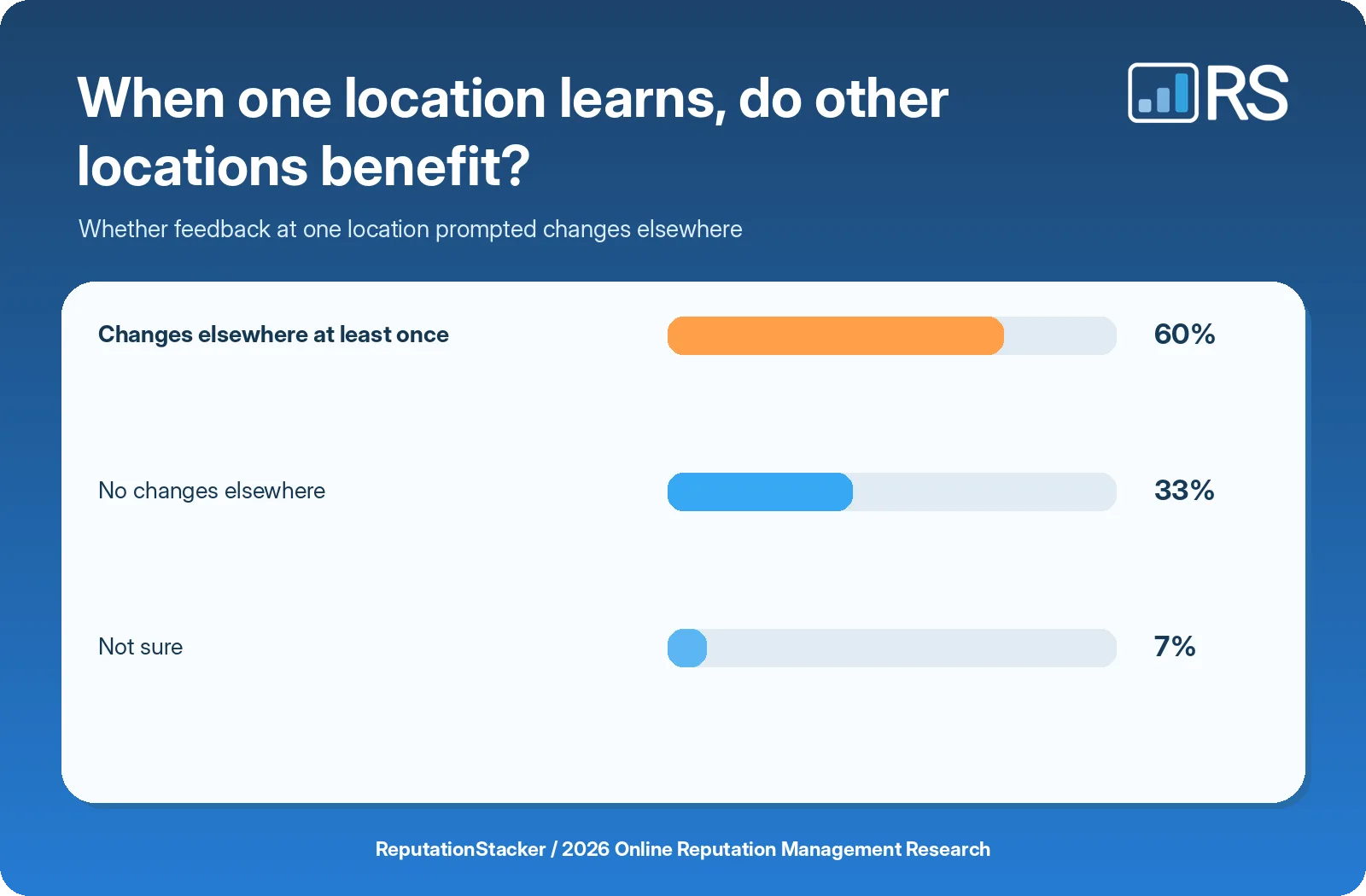
60% reported that customer feedback at one location had prompted a change at another location at least once. 25% said that had happened multiple times.
A booking problem at one branch may exist elsewhere. Likewise, an unusually well-reviewed branch might have a staffing or customer-service practice worth trying across the network.
That only works when someone sees the relationship between locations. Otherwise every branch gets to learn the same expensive lesson on its own.
Our customer feedback analysis research looks at how businesses recognize recurring issues and whether they measure improvements.
Local judgment and corporate consistency both matter
A centralized review policy and local discretion aren’t enemies. The important question is which decisions need to be standardized.
A complaint involving safety or a sensitive customer dispute may deserve an escalation rule. A routine thank-you doesn’t need to pass through three layers of management. And local managers should have a way to add context before someone at headquarters replies on their behalf.
The survey’s shared-responsibility finding suggests plenty of businesses are already trying to strike that balance. But reporting, approvals, and escalation rules still need to work together.
ReputationStacker’s multi-location reputation management and retail and franchise solution address the need for common oversight across individual locations. Our AI reputation management research covers the additional question of how much automation businesses are comfortable approving.
Most businesses don’t formally use review feedback to assess managers
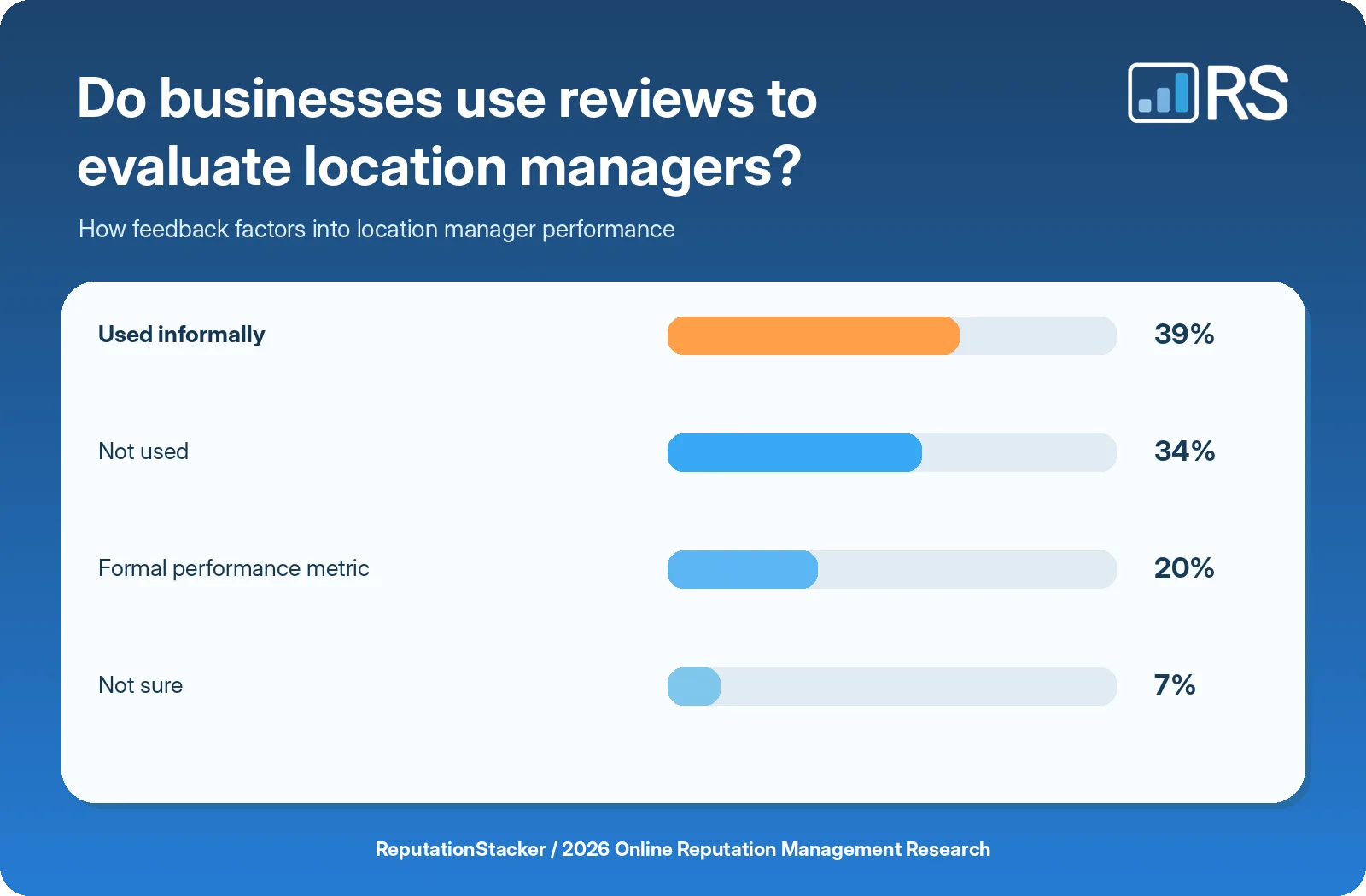
39% use customer feedback informally in manager evaluations. 20% make it a formal performance measure; 34% don’t use it for that purpose.
A rating isn’t a fair performance review by itself. Complaint themes are often more informative: repeated reports of rude interactions, missed appointments, or unanswered calls may point to things a manager can influence. An isolated angry review may not.
A good reporting process gives the manager a chance to explain the circumstances and shows whether the problem is recurring, improving, or spreading to other branches.
The case for a coordinated reputation management system
At scale, two jobs have to happen together: people on the ground need to respond intelligently to customers, and headquarters needs to see what’s happening across the network.
ReputationStacker’s Review Requests, Review Monitoring, and Location Review Analytics cover the recurring work. AI Review Insights helps investigate the actual comments behind those numbers.
For a regional manager with dozens of locations, a report should answer where to look first. If it takes an afternoon of spreadsheet work just to figure that out, the process needs attention.
Conclusion: Every branch has something to teach the others
Most multi-location businesses can tell you who’s responsible for reviews. Far fewer have a consistent way to compare what customers are saying across their locations.
When teams share what works, a fix discovered at one branch can help the entire network. That’s an advantage single-location competitors can’t replicate as easily.
ReputationStacker helps businesses make those comparisons, identify problems worth investigating, and keep local teams involved in fixing them. The goal isn’t to make every branch sound identical. It’s to stop the organization from having to solve the same customer problem over and over.
Related ReputationStacker research
- 2026 State of Online Reputation Management & Customer Experience
- AI in Reputation Management: 2026 Research & Trends
- Customer Feedback Analysis: 2026 Research & Trends
About the research
This ReputationStacker 2026 study includes 419 survey records, including partial responses, from business owners, managers, and others involved in reputation management and customer experience. Multi-location questions were asked of businesses with two or more locations. Results describe those respondents’ self-reported practices and are not representative of all multi-location businesses.
