
Original research from ReputationStacker
Businesses have invested a lot of effort in online reviews. Many now have a process for requesting them, monitoring their ratings, and responding to complaints. That’s progress.
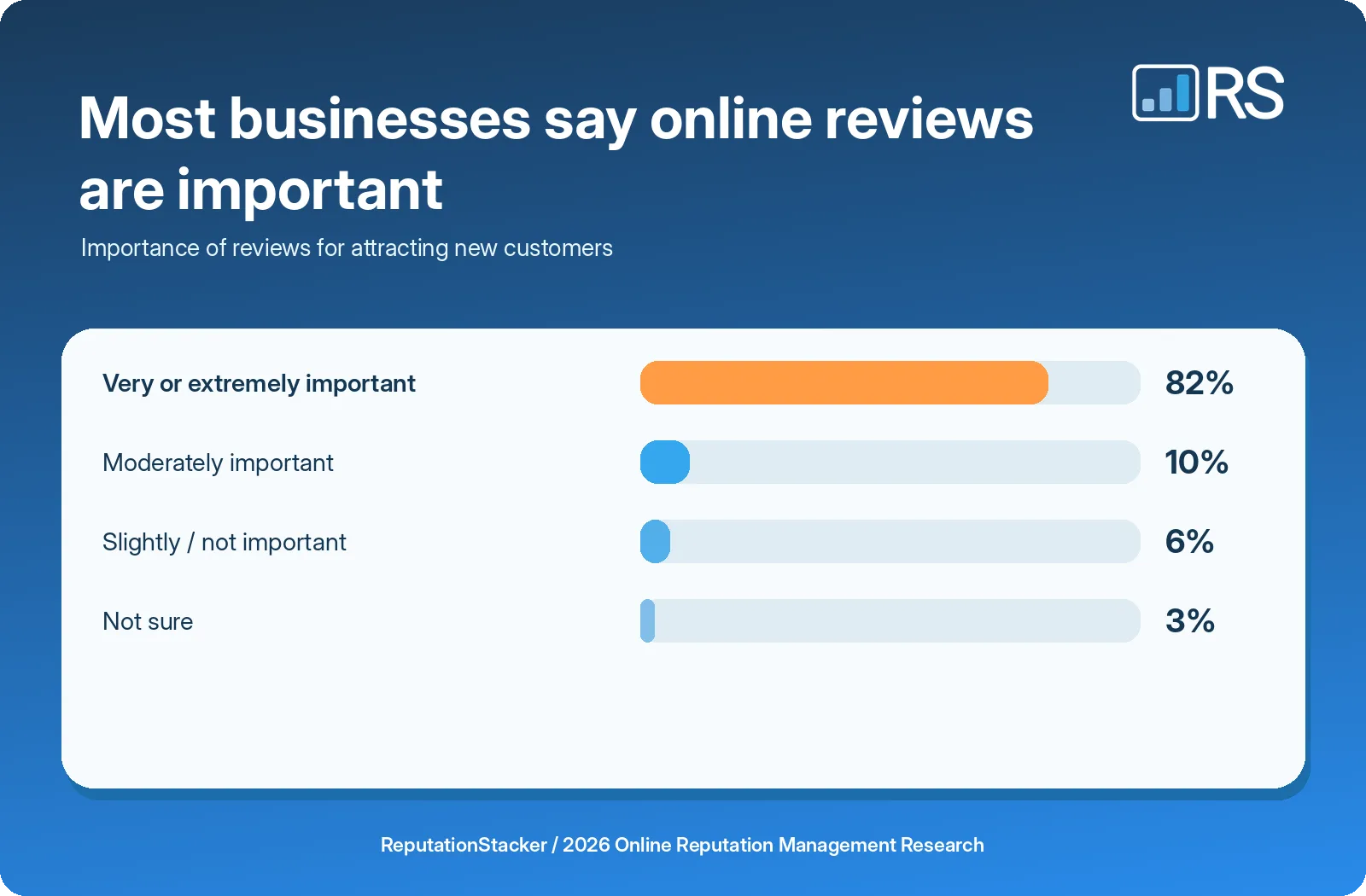
Here’s what caught our attention in ReputationStacker’s 2026 research: 82% of respondents say reviews are very or extremely important for attracting customers, yet 45% still read them individually without any formal trend analysis. And among businesses that make changes because of customer feedback, plenty have no reliable way to tell whether the changes helped.
Those reviews contain firsthand accounts of what customers liked, what frustrated them, and what might stop them from returning. Too often, that information gets handled as a public-relations task rather than something managers can use to improve the business.
That’s a missed opportunity, especially when the same complaints show up over and over.
We surveyed businesses about review generation, customer feedback, AI, multi-location management, and the financial value of reputation management. Here are the findings we think deserve the most attention.
Key findings from ReputationStacker’s 2026 research
- 82% say online reviews are very or extremely important for attracting new customers.
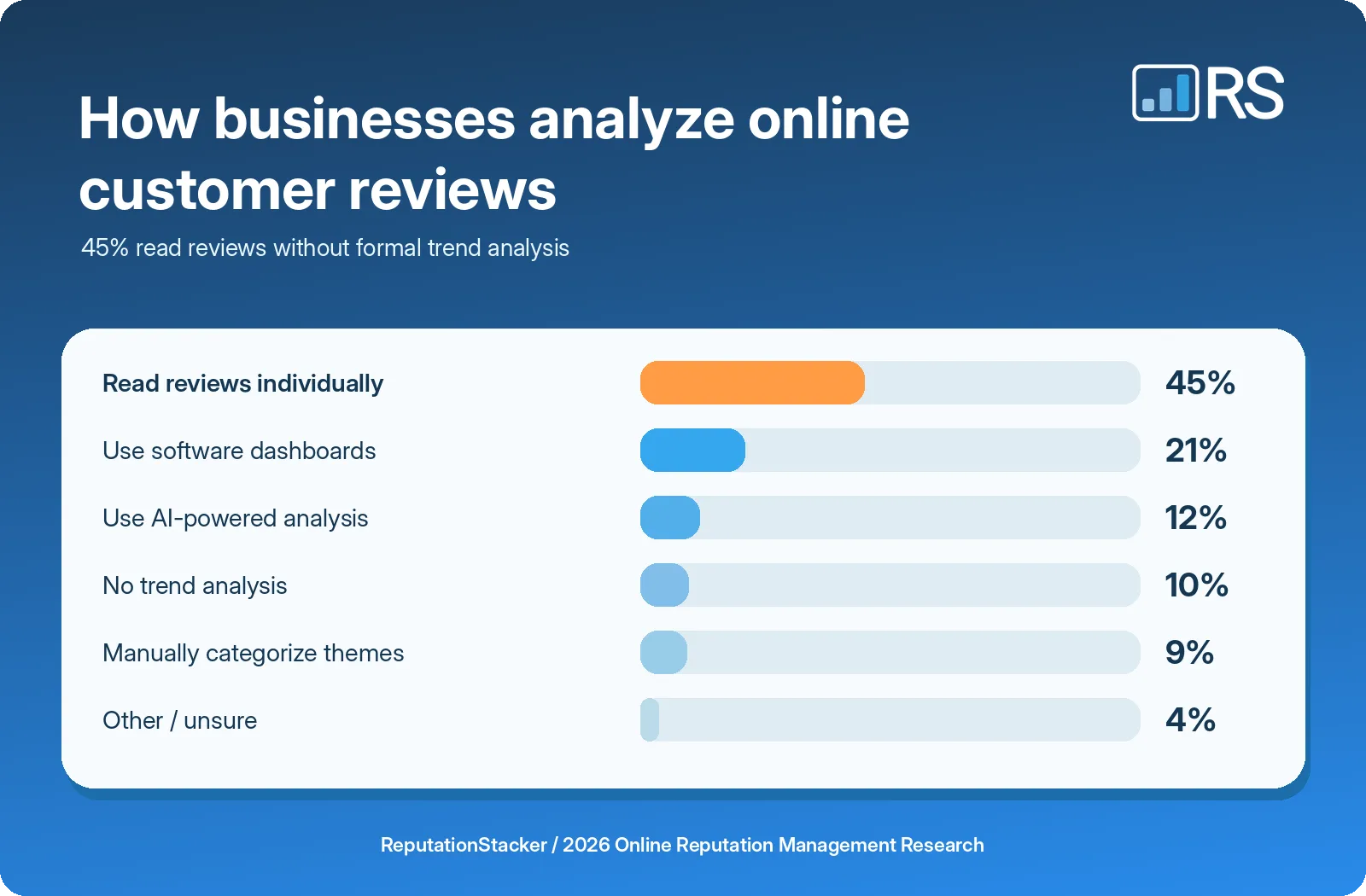
- 45% read customer reviews individually without formal trend analysis; 12% use AI-powered review analysis.
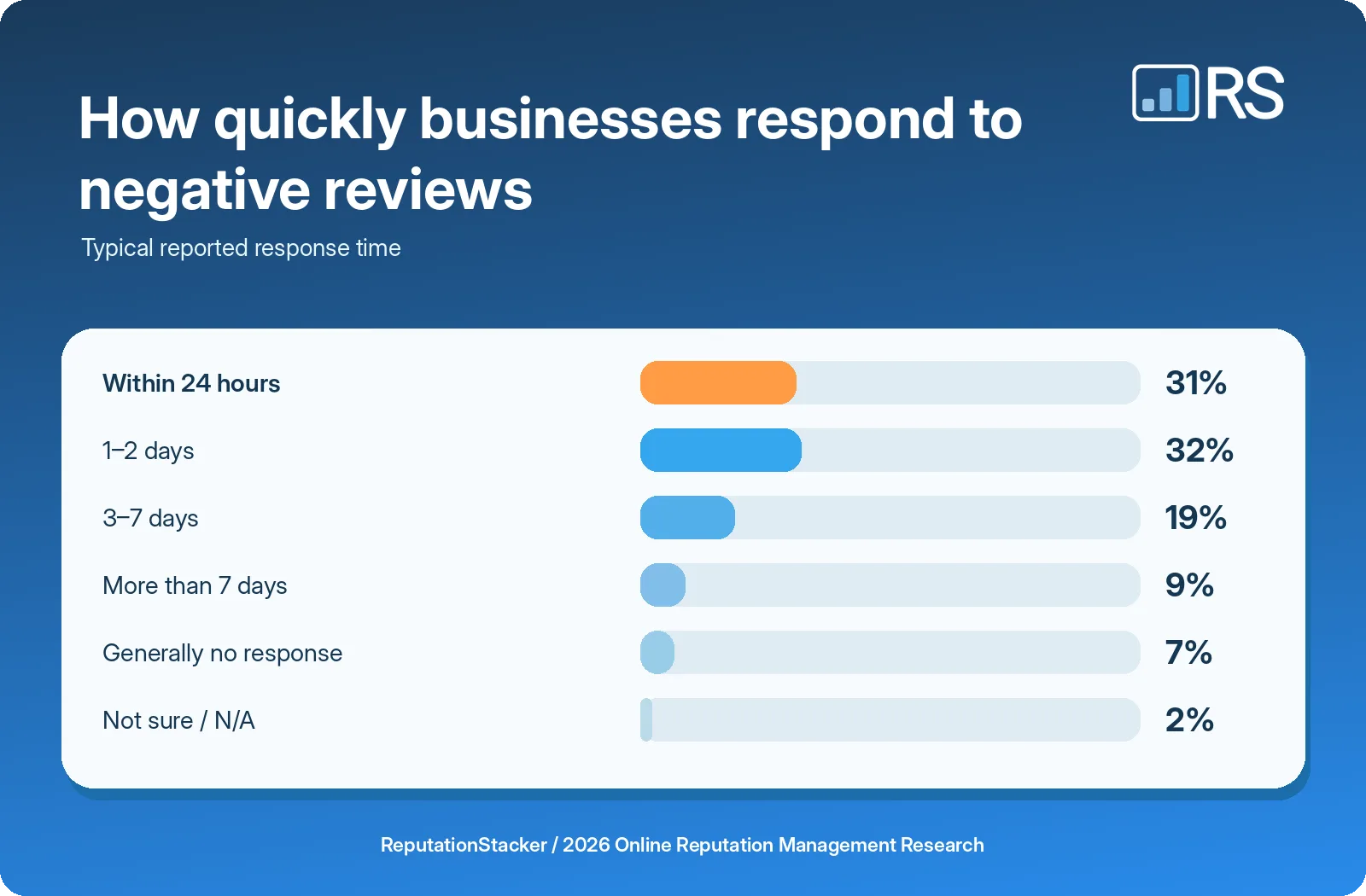
- 63% say they typically respond to negative reviews within one or two days.
- 51% reported using AI for reputation management or customer-feedback analysis in the previous year.
- 46% don’t measure whether improvements made because of customer feedback actually improve satisfaction.
- 47% have little or no confidence in calculating the financial return on reputation management.
82% say online reviews are important for attracting customers
That 82% figure probably won’t surprise anyone running a business today. A strong rating helps people feel comfortable choosing you. A weak rating gives them an excellent reason to keep scrolling.
The more revealing result came from a different question.
When we asked how businesses identify patterns in their written reviews, the most common answer was that they read the reviews individually. That was the approach taken by 45% of respondents. Only 21% use software reports or dashboards for the job, and 12% use AI-powered analysis.
Reading individual reviews still matters. It’s how you pick up details and context that a dashboard can miss.
But let’s say your business has received 200 reviews over the past few months. Somewhere in those reviews are 18 complaints about people struggling to reach someone by phone. The complaints are scattered among compliments about your staff, comments about pricing, and unrelated complaints about store hours.
Read one review at a time, and those phone complaints can seem unrelated. Look at them together, and you may have a staffing or call-handling problem that deserves attention.
That’s why we built AI Review Insights into ReputationStacker. It analyzes what customers are saying across reviews and lets you ask follow-up questions in plain English. For example: Are complaints about phone calls increasing? Which locations are customers most frustrated with? What do our highest-rated locations consistently do well?
Managers still have to investigate the cause and decide how to respond. The analysis gives them a much better place to start.
Review requests: Many businesses still rely on employees remembering to ask
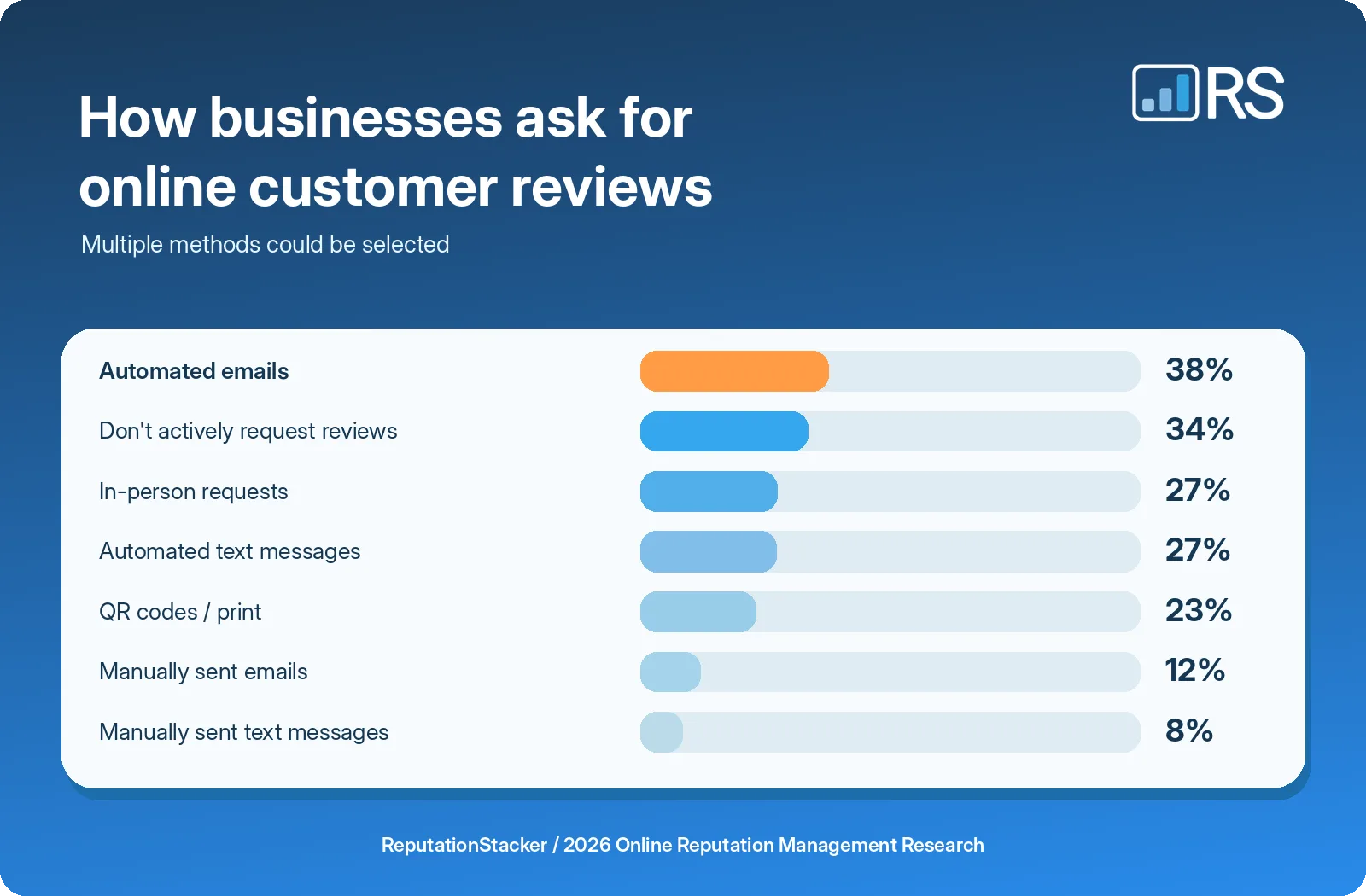
Our survey found 38% of businesses use automated email review requests, 27% use automated text messages, and 27% ask customers in person. Respondents could select more than one method. Those numbers tell us automated requests are established, but hardly universal. And for businesses relying on manual requests, consistency is a real operational challenge.
Asking in person can work very well, particularly when staff have good relationships with customers.
The challenge is making those requests consistently across shifts, employees, and locations.
When review generation depends entirely on staff remembering to ask, it tends to fluctuate. One employee remembers, another forgets, and a particularly busy afternoon can disrupt the process altogether.
ReputationStacker’s automated review requests can be sent by email or text after a customer interaction. The business gets a dependable process without relying on staff to send each one manually.
The point is to make asking for reviews routine, rather than a task that gets skipped when the front desk is busy.
63% typically respond to negative reviews within one or two days
On response time, the results were encouraging: 31% of respondents said they typically respond to negative reviews within 24 hours, while another 32% respond within one to two days.
That’s a reasonably prompt response for most complaints. The question is what the business says when it responds.
A generic response promising to ‘strive for excellence’ doesn’t help much when the customer has described a specific billing error or a rude encounter. It suggests the business is answering the rating without paying much attention to the complaint.
A useful reply should demonstrate that somebody read the review. It should address the complaint, sound like the business, and give the customer a sensible next step when appropriate.
For a business receiving a handful of reviews a week, that’s manageable. For a company juggling dozens of locations and hundreds of reviews, it’s a different story. ReputationStacker’s AI Review Replies helps teams draft relevant, natural responses more quickly. They can spend less time composing replies from scratch and more time handling the situations that require actual judgment.
Businesses are changing things because of feedback. Nearly half aren’t checking the results.
We asked businesses how often customer feedback had led to documented operational changes during the previous year.
61% reported making at least one change. Another 32% said they hadn’t made any.
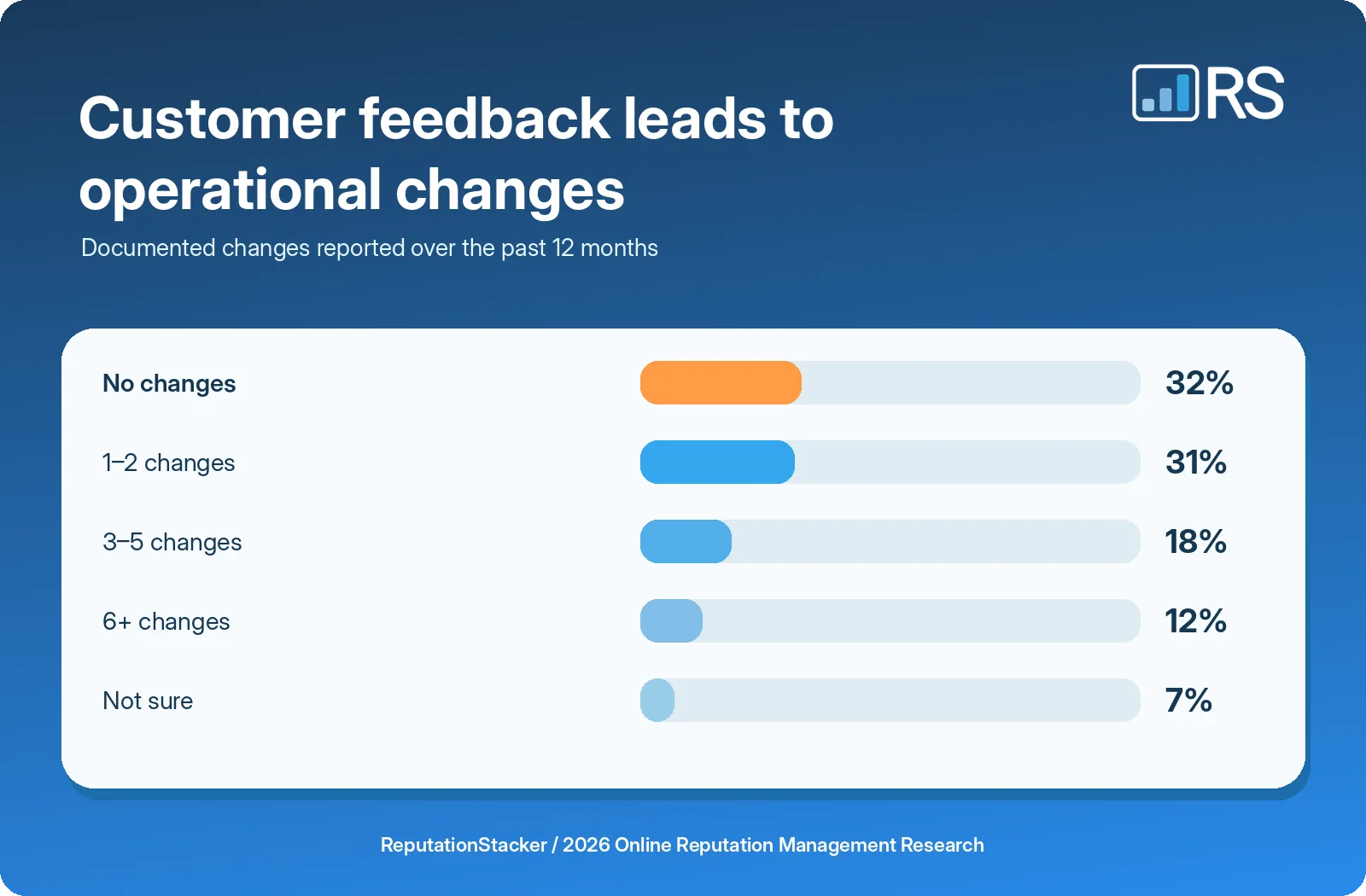
Those changes can reach well beyond marketing. Customers comment on scheduling, delivery problems, slow service, confusing policies, and employee behavior—things that directly affect how a business operates.
But then we asked whether businesses measure the effect of changes made in response to customer feedback.
46% said they don’t measure whether those changes improve customer satisfaction. Only 13% said they measure the results systematically.
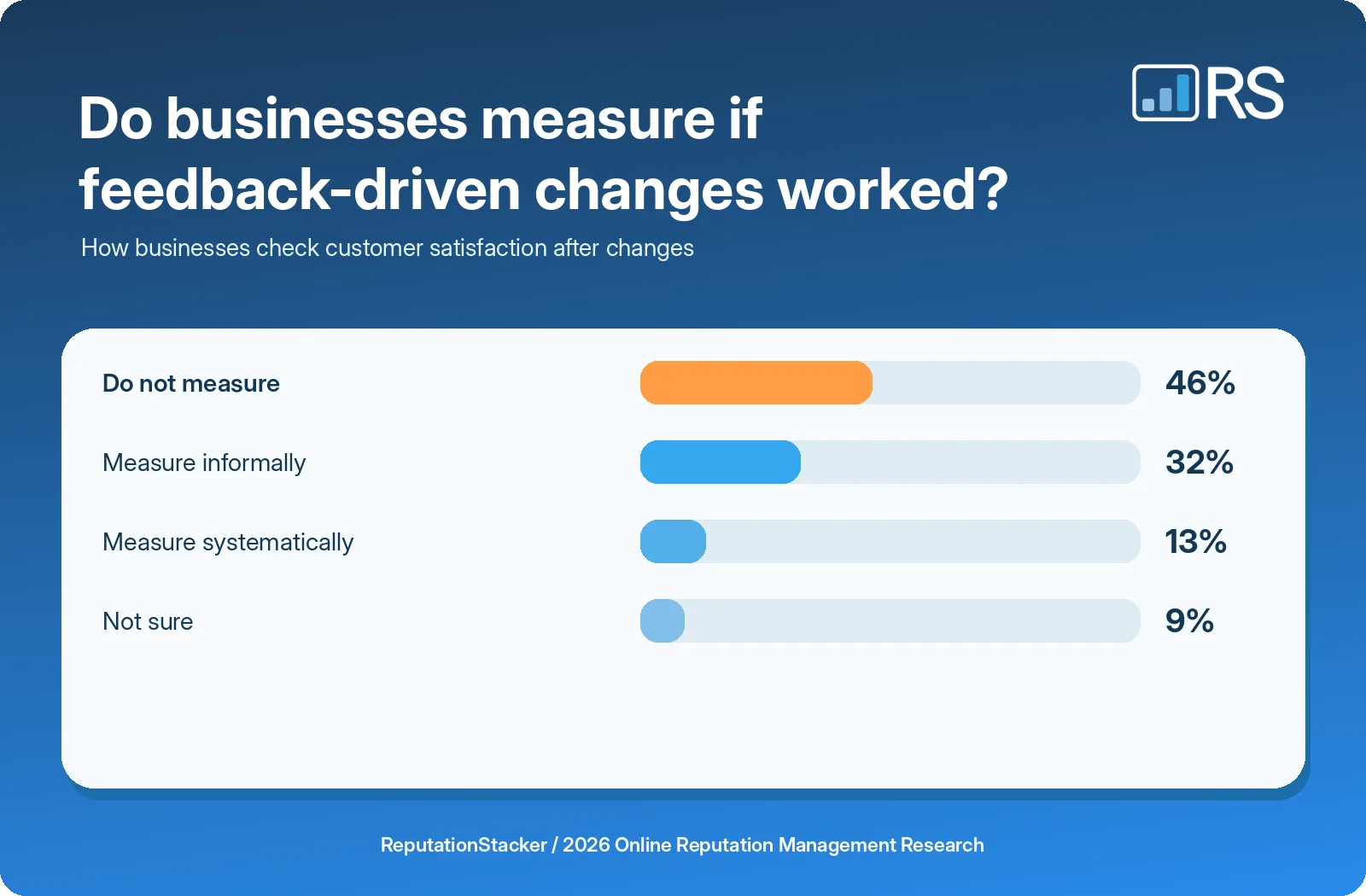
Imagine a regional manager notices repeated complaints about long checkout lines, so she adds another cashier during peak hours. A month later, are people still complaining about checkout times? Has the change helped, or has the problem simply shifted to another location? A manager needs that answer before deciding whether the new staffing plan should become permanent.
Sometimes businesses can tell that a change worked without an elaborate measurement system. But if you’ve made a significant operational decision because customers complained, it’s worth checking whether those customers are still complaining.
There’s also the matter of discovering problems in the first place. 43% of respondents said reviews had revealed an operational problem before internal reporting or employee feedback did. And 48% said customer feedback had exposed a staff-performance or training issue.
Internal reporting can look normal even when the customer experience isn’t. Review comments are one way to discover where those two pictures differ.
ReputationStacker’s customer feedback tools help businesses collect and review that information so managers can see the problems—and the praise—that might otherwise never reach them.
For a closer look at adoption, oversight and reported time savings, see our 2026 research on AI in reputation management.
51% are using AI for reputation management. What are they getting from it?
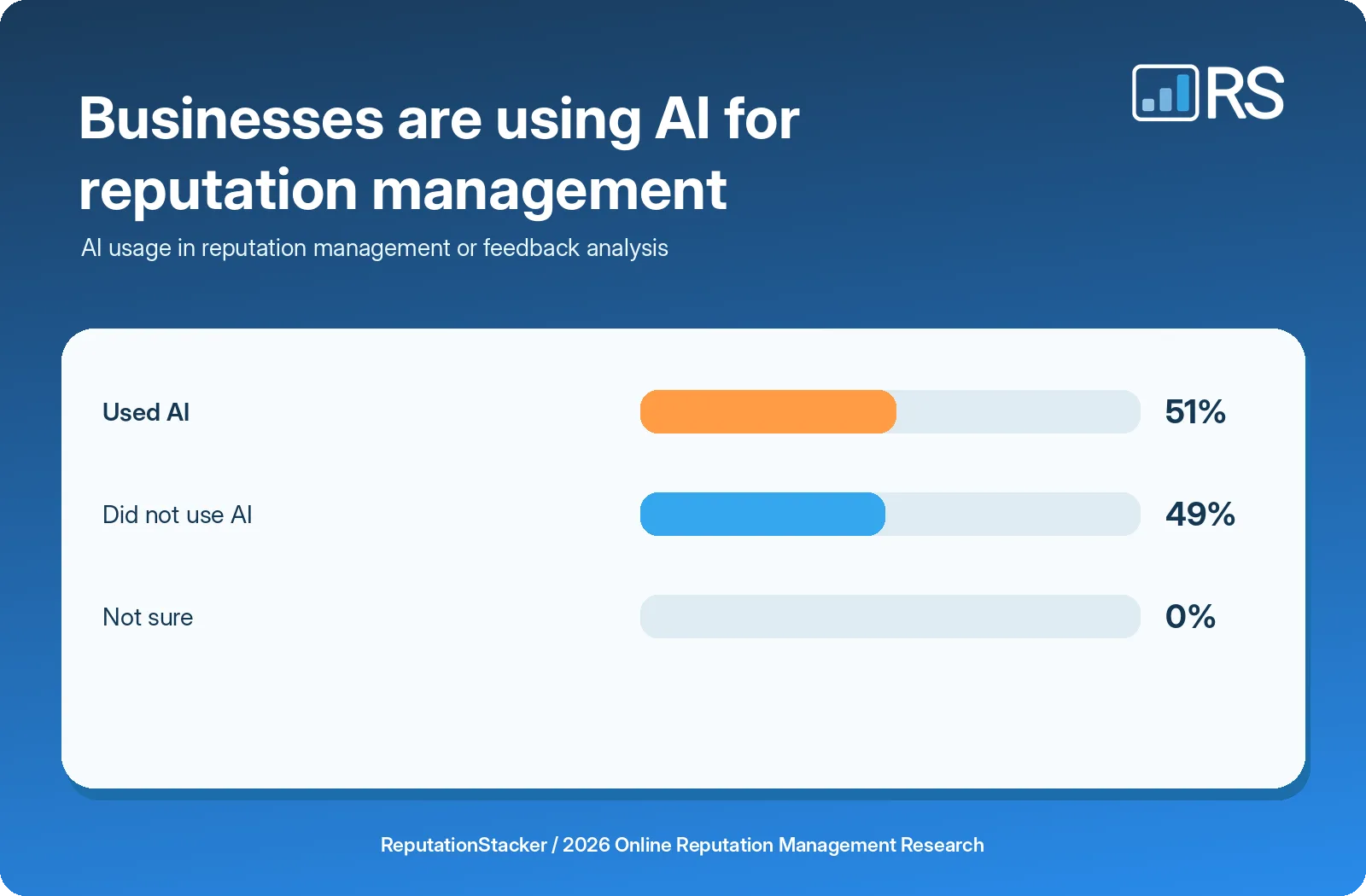
51% of respondents reported using AI for reputation management or customer-feedback analysis during the previous year.
Among respondents asked about AI time savings, 44% reported saving one to four hours per week, while 25% reported saving five to ten hours.
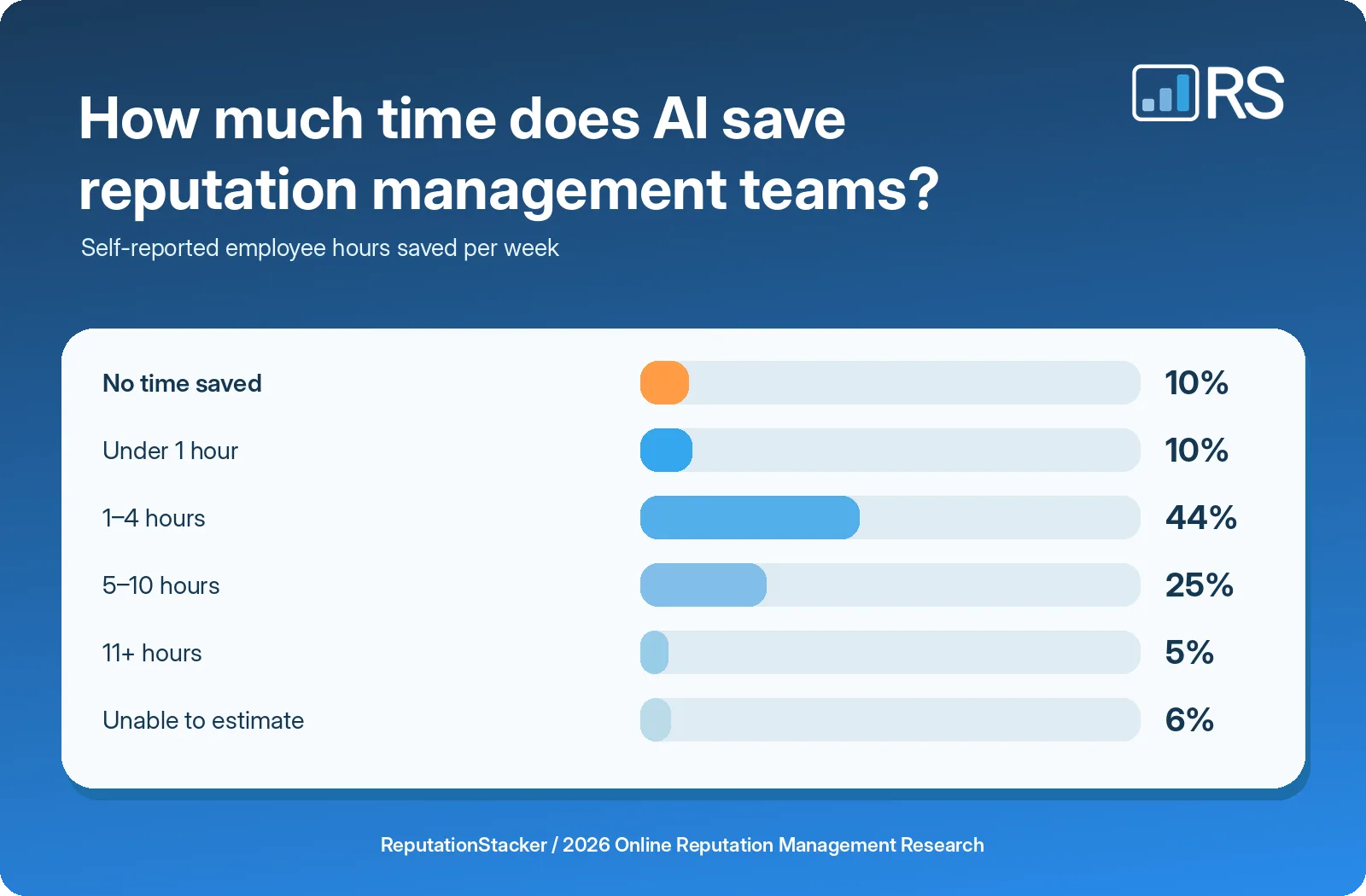
Saving several hours a week on review responses is useful. We find the potential for better analysis even more interesting.
Think about the difference between asking AI to write a polite response to a negative review and asking it to examine the last six months of customer feedback to identify recurring complaints. Both can be useful. One saves time on a task you already knew needed doing. The other might alert you to something you hadn’t noticed.
Among respondents asked whether AI feedback analysis had uncovered an unfamiliar issue, 61% said it had identified a problem or trend they hadn’t previously recognized. It’s a narrower result than the headline AI-adoption number, but it suggests an interesting direction for businesses that have moved beyond generating responses.
AI summaries can also be unhelpfully vague. ‘Customers value convenience and excellent service’ tells a manager very little. You want specifics: what customers are complaining about, whether those complaints are getting worse, and where they’re happening.
That’s the kind of questioning ReputationStacker’s AI Review Insights is built for.
Are businesses checking their visibility in AI-generated recommendations?
We also asked whether businesses check how they appear when people use AI tools to look for business recommendations.
45% said they’d never checked.
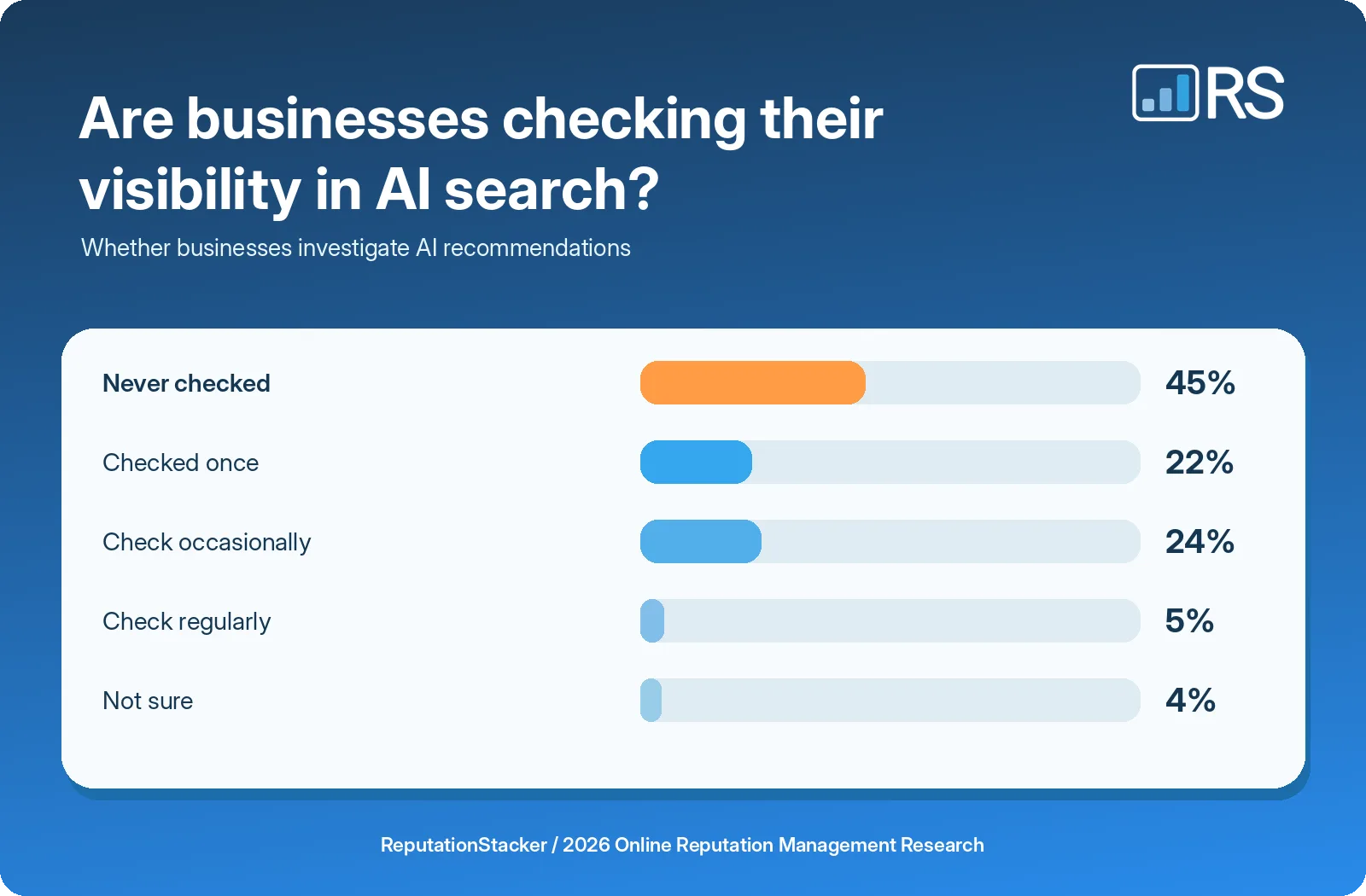
Businesses have spent years worrying about where they show up on Google. Now people are also asking AI assistants which companies to hire, which restaurants to visit, and which services are worth paying for.
It’s not worth overreacting to any single ChatGPT answer. Recommendations can vary depending on the question, location, and other factors. But if customers in your market are increasingly using these tools, you should at least have some idea of whether your business is showing up—and how it’s being described.
We explore the feedback-analysis findings in more detail in our 2026 customer feedback analysis report.
Multi-location reputation management gets complicated quickly
One location has a 4.8-star average. Another has a 4.3. That difference is obvious.
But what if your 4.8-star location is beginning to receive complaints about rude staff, while the 4.3-star location has dramatically improved over the past six months? Which location needs attention first?
That’s where companywide averages stop being especially helpful.
Among respondents to our multi-location reporting question, 30% said they compare locations informally, 27% use centralized dashboards, 25% rely on reports or spreadsheets, and 15% don’t compare locations at all.
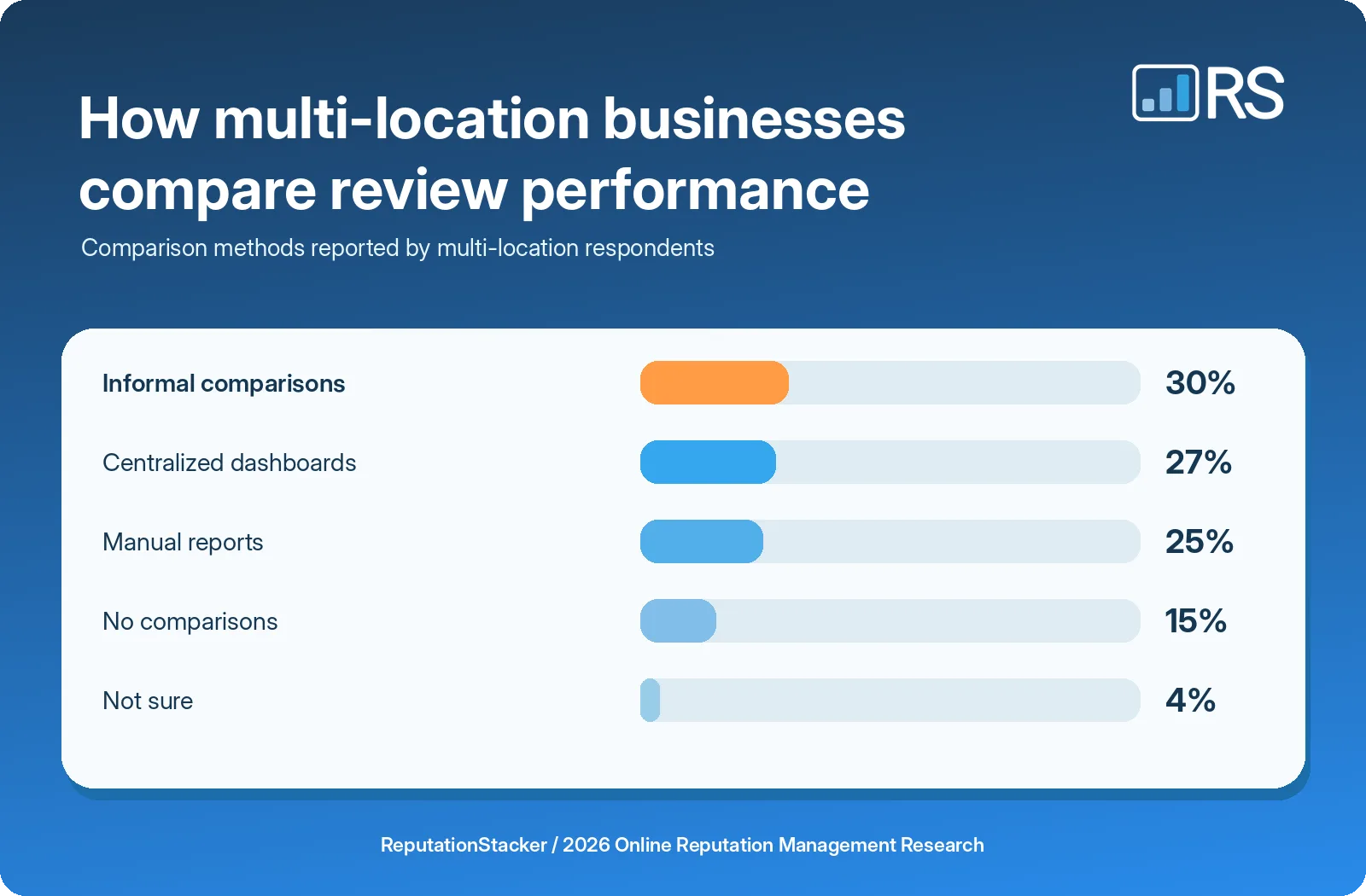
Keeping track of the details gets harder with every location you add. One manager may be great at responding to complaints, while another lets them sit for weeks. One branch gets consistent praise for its staff. Another has an ongoing scheduling problem that nobody at headquarters knows about.
Location Review Analytics helps businesses compare what’s happening at each location. For organizations managing more complex networks, ReputationStacker’s multi-location reputation management tools bring review activity and customer feedback into a centralized system.
Having a single place to look doesn’t magically make every branch better. It does make it harder for an obvious problem to go unnoticed.
Our multi-location reputation management research examines how teams compare branches and share improvements across locations.
How reputation management practices vary by industry
AI adoption isn’t uniform. Healthcare businesses also show a substantial gap in review requests, while some home-services and dental respondents reported not measuring whether changes prompted by feedback improved satisfaction.
| Industry | Finding |
|---|---|
| Home services | 29% reported using AI for reputation management or feedback |
| Automotive | 63% reported using AI for reputation management or feedback |
| Fitness / wellness / beauty | 69% reported using AI for reputation management or feedback |
| Healthcare | 46% don’t actively request reviews |
| Home services | 57% don’t measure whether feedback-driven changes improve satisfaction |
| Dental | 58% don’t measure whether feedback-driven changes improve satisfaction |
These are results from the businesses surveyed, not industrywide rankings. The variation is useful for deciding what to investigate, especially where basic review requests and follow-up measurement are being missed.
Nearly half can’t confidently calculate their reputation management ROI
When we asked about the financial return on reputation management, 47% said they were not at all or only slightly confident they could calculate it. Just 16% were very or extremely confident.
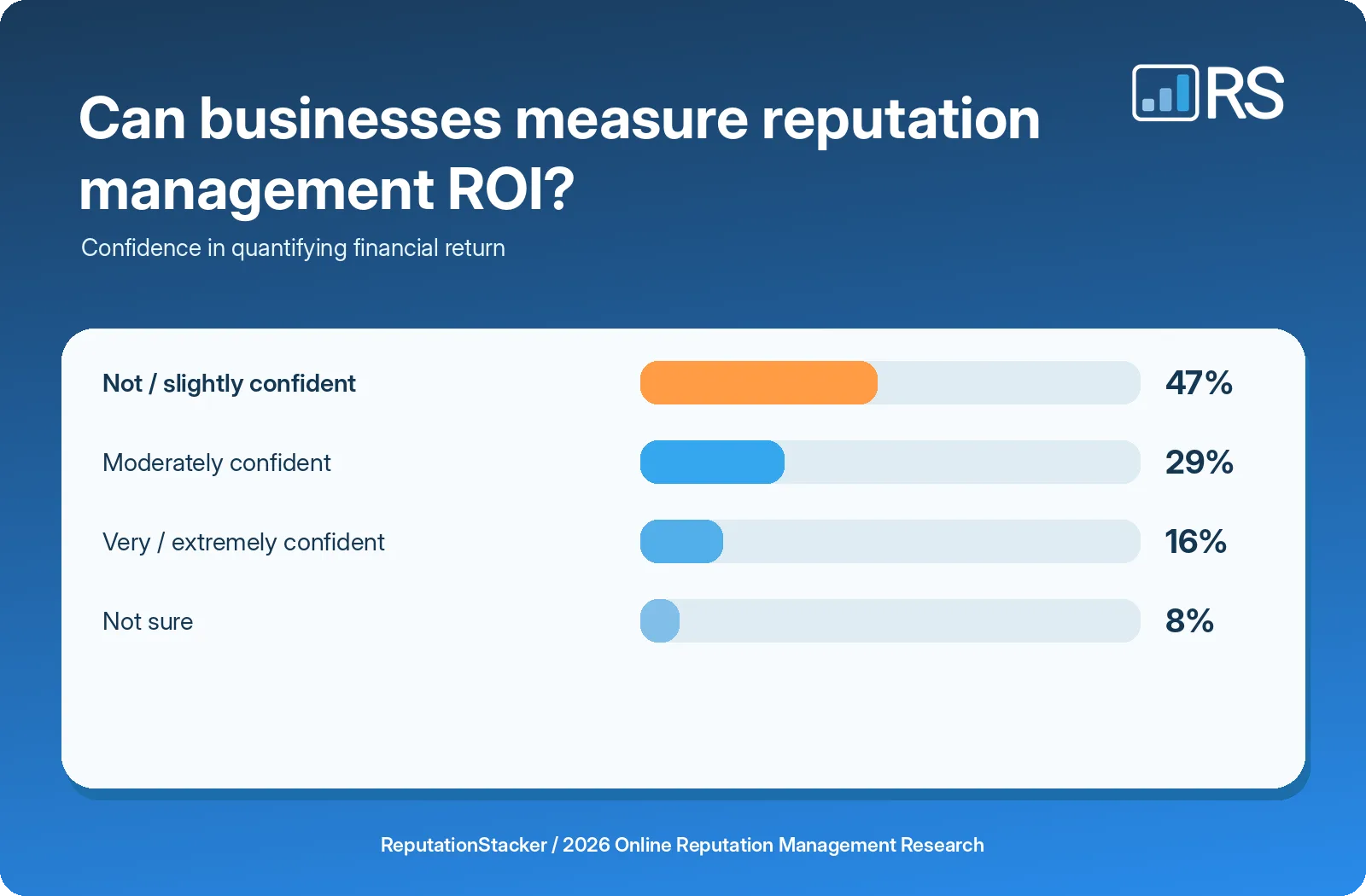
We can see why.
How do you prove that someone picked your business because of its Google reviews? They might have found you through a search, heard about you from a friend, compared several companies, and then checked your reviews before making a decision.
It’s tempting to put a tidy revenue figure on a presentation slide: Our online reviews generated $327,000 this quarter. But without credible attribution, that figure tells management very little. A precise-looking estimate isn’t necessarily an accurate one.
There are still plenty of things worth measuring: review volume and rating trends, response activity, incoming inquiries, repeat complaints, and whether operational changes are followed by better customer feedback. Those measures won’t automatically establish revenue attribution, but they can help a business figure out whether its reputation management program is working.
And if the reviews are helping you fix problems that cost you customers, that matters too—even when you can’t attach an exact dollar figure to every improvement.
What should businesses actually do with these findings?
We wouldn’t overhaul a reputation management program based on a single survey. But these results do suggest several useful questions for businesses evaluating their approach:
- Are we consistently asking customers for reviews? Or does it depend on who’s working that day?
- Are we responding to the actual complaints? Or do we have a library of polite responses that say almost nothing?
- Do we know what customers complain about most often? Not just our average rating, but the problems that keep coming up.
- When we fix something, do we check whether customers notice?
- If we have multiple locations, can we tell which ones need attention and why?
The answers can help determine whether a business needs better review-request processes, better reporting, or more consistent follow-through on customer complaints.
Where ReputationStacker fits in
ReputationStacker conducted this research, and the problems respondents described are closely related to what our platform is built to address. We also think the findings offer useful criteria for evaluating any reputation management software.
It should reliably help you get reviews, make it practical to monitor and respond to them, and give managers a way to understand what customers are actually saying—especially as the business grows.
ReputationStacker handles automated review requests, AI Review Replies, and customer feedback collection. Its Location Review Analytics helps businesses manage performance across branches, and AI Review Insights lets managers investigate review trends and ask follow-up questions about the customer experience.
It’s a complete online reputation management platform for businesses with one location or thousands of them. And the point of putting these tools together is simple: managers shouldn’t need to piece together half a dozen systems—or read every review manually—to understand what customers are telling them.
Explore ReputationStacker to see how those capabilities work together.
Conclusion: Getting serious about what customers are telling you
Businesses have plenty of reasons to care about online reviews. They help people decide whom to trust, and they can have a very real influence on whether someone gives your company a chance.
Our research suggests that most businesses already understand that part.
What matters is whether those reviews also reach the people who can solve recurring problems. A customer leaves a review saying the staff was wonderful but the scheduling process was terrible. Another says basically the same thing a week later. Then another. At some point, you have a choice: keep responding to the reviews, or fix the scheduling process.
The business should respond to the customer and investigate the scheduling problem.
That approach is central to ReputationStacker. Review generation and response management help businesses build and maintain their online reputation. Our feedback analytics and AI Review Insights help them understand the experience behind those ratings—and identify issues worth fixing.
A strong online reputation helps customers choose a business. Understanding what drives that reputation can help the business earn it again tomorrow.
Related ReputationStacker research
- AI in Reputation Management: 2026 Research & Trends
- Customer Feedback Analysis: 2026 Research & Trends
- Multi-Location Reputation Management: 2026 Research & Trends
About the research
This 2026 ReputationStacker study includes 419 survey records, including partial responses, from business owners, managers, and others involved in reputation management and customer experience. Respondents included current and former ReputationStacker users and other businesses. Percentages reflect those who answered each question, so response totals vary. The survey measures reported practices and opinions, rather than independently observed business performance, and is not a representative sample of all businesses.
