
Original research from ReputationStacker
It’s easy to add ‘AI-powered’ to a reputation management product description. Much harder to explain precisely what that means for the person handling customer reviews at 5 p.m. on a Friday. Is the software drafting a response? Identifying a problem across several locations? Or doing something nobody on the team actually needs?
We asked businesses which tasks they’ve actually tried, what they trust AI to do, and whether it has been useful. 51% reported using AI for reputation management or customer-feedback analysis during the previous year. The rest hadn’t reported using it.
Key findings: AI in reputation management
- 51% reported using AI for online reputation management or customer-feedback work in the preceding year.
- 44% of those answering the AI time-savings question estimated savings of one to four hours a week; another 25% estimated five to ten hours.
- 56% of respondents using AI review replies require approval before every AI-generated response is published.
- 30% cited robotic or generic responses as an AI concern; 29% cited accuracy or reliability, and 29% cited privacy or compliance.
- 63% expect AI to be very or extremely important to reputation management within three years.
Half of respondents have used AI for reputation management
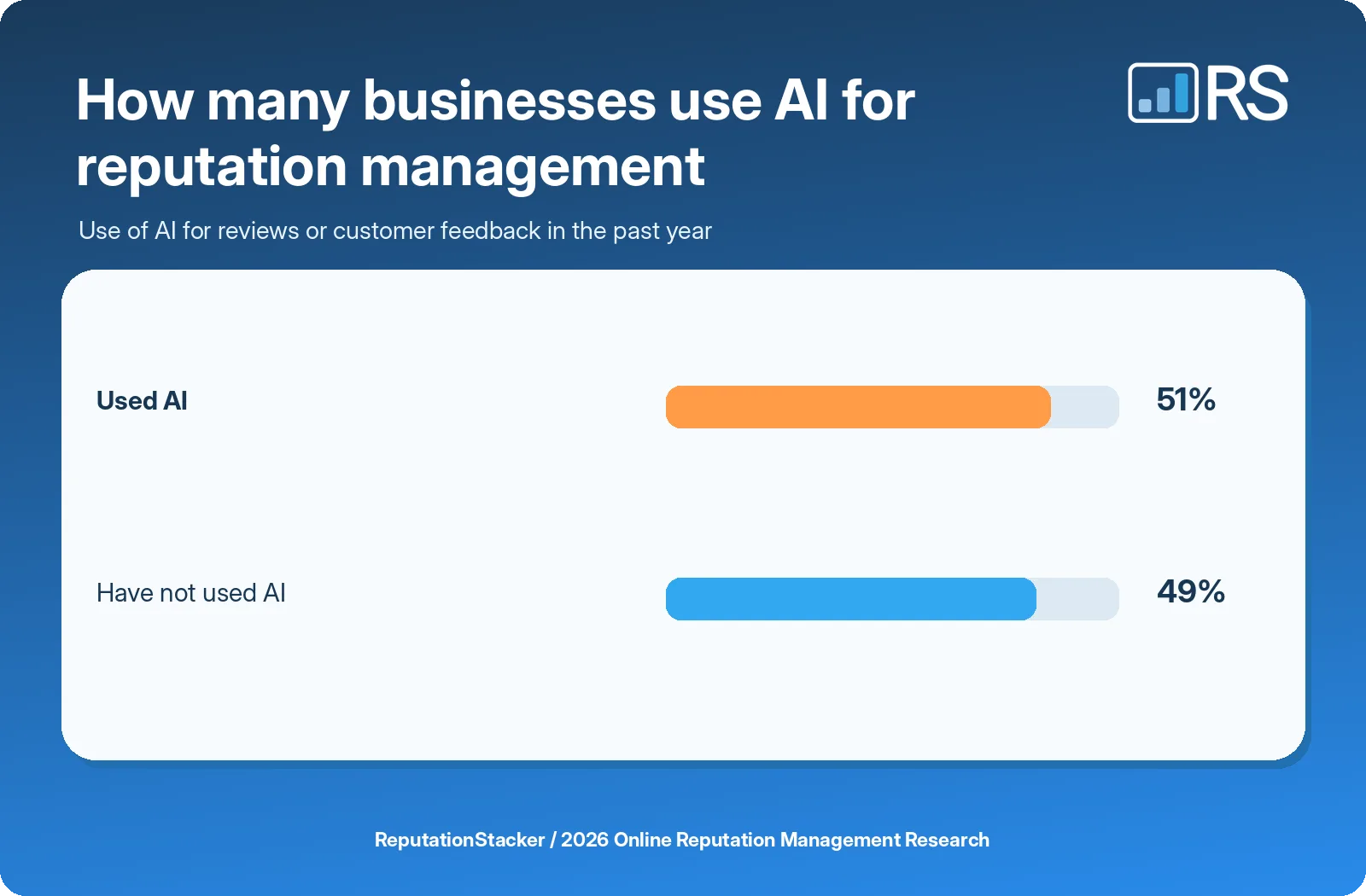
51% said they’d used AI for reputation management or customer-feedback analysis during the preceding year. That sounds like AI is everywhere. The details are more interesting.
In a separate question asking about specific AI applications, 19% selected generating replies to reviews, 14% selected identifying recurring feedback themes, and 11% selected sentiment analysis. Respondents could select more than one application. This more specific question paints a different picture of where AI is being used.
There’s clearly a gap between saying a business has used AI and knowing exactly where it fits into review management. That’s not a criticism. A tool that writes a decent response to a five-star review is quite different from one that can answer why complaints are rising at three locations.
Businesses report time savings, but they still want control
Among respondents answering the time-savings question, 44% estimated that AI saved one to four hours weekly and 25% estimated five to ten hours.
Time savings matter. But a review reply appears publicly under the business’s name, so the manager still has a reason to pay attention to what goes out.
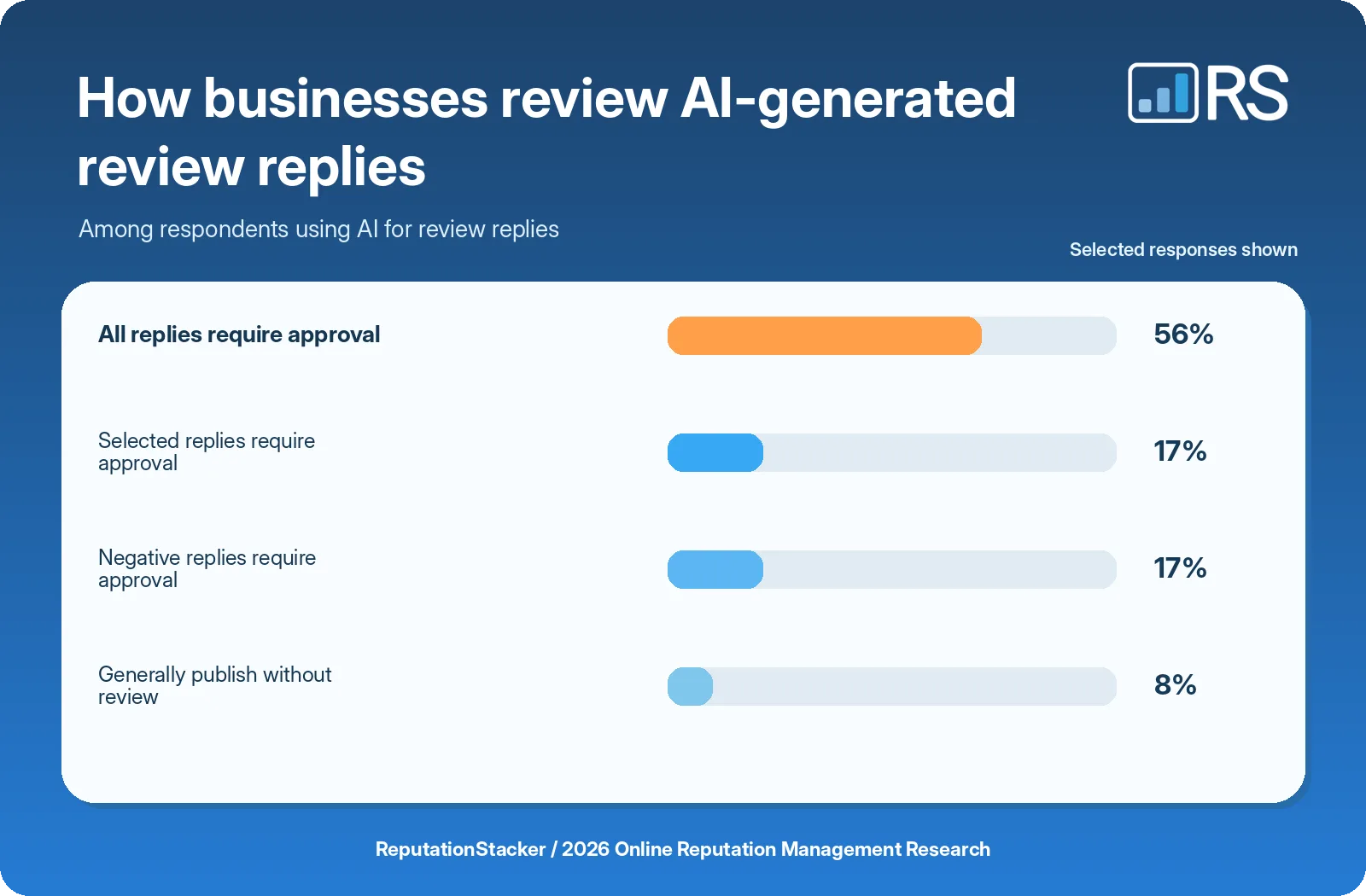
Of those answering the review-reply oversight question, 56% require someone to approve every AI-generated reply before publication. Another 17% review selected replies, 17% require approval for negative-review replies, and 8% generally publish without human review.
That split says something useful about the current market: businesses are comfortable getting help with the writing, but many are reluctant to hand over final judgment. And they’re right to distinguish a routine thank-you from a review describing a billing dispute or an unsafe experience.
AI Review Replies helps ReputationStacker users draft responses to individual reviews without starting from scratch each time.
Businesses worry most about generic AI responses, accuracy, and privacy
Respondents were more worried about the content of AI’s output than about anything futuristic.
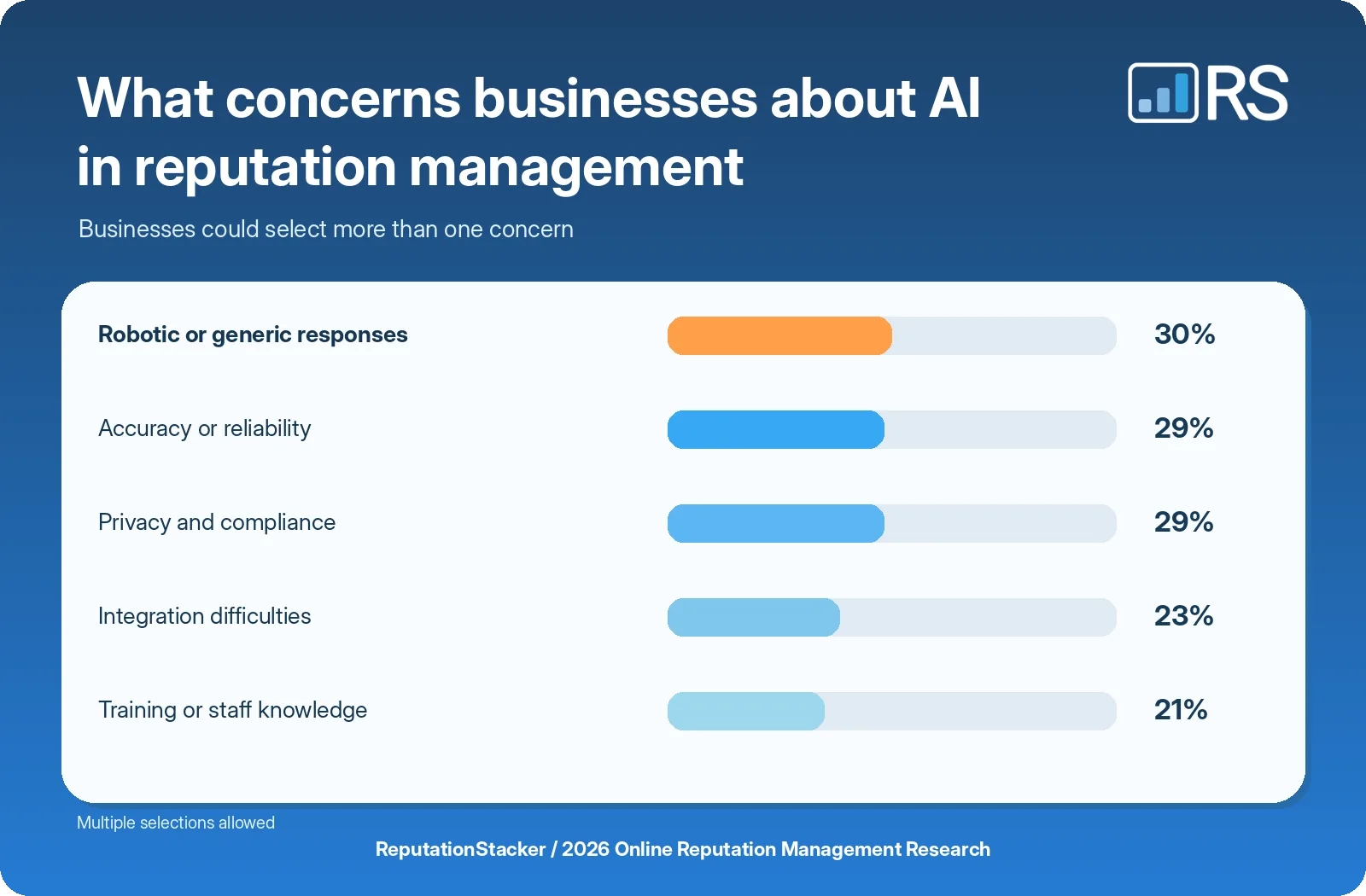
30% worried that responses would sound robotic or generic, 29% cited accuracy, and 29% cited privacy or compliance. Integration problems (23%) and employee training (21%) were also common selections. Respondents could select multiple concerns.
It’s a practical list. An AI response that invents a promised refund, misses the complaint, or sounds as though nobody read the review can create work instead of saving it.
There is encouraging evidence from businesses already using AI replies: 77% of those who rated their satisfaction said they were satisfied or very satisfied.
61% of AI feedback-analysis respondents discovered an unexpected issue or trend
Writing review replies saves time. Analyzing reviews can change what managers decide to do.
Say a regional manager notices that the overall rating looks steady but customers at several branches have begun mentioning unavailable appointments. Reading a few recent reviews at each branch could easily miss it. Comparing themes across locations makes the pattern easier to investigate.
Among respondents answering the AI feedback-analysis question, 61% reported that AI had uncovered a previously unrecognized issue or trend at least once. For a manager, finding a repeated problem before it grows is a far better use of AI than producing another generic summary.
ReputationStacker’s AI Review Insights lets managers analyze written feedback and ask follow-up questions about trends, complaints, and praise. Review Sentiment Analysis uses natural language processing (NLP) to identify positive and negative mentions within customizable categories like staff, service, and pricing. It turns written reviews into comparable sentiment data, including across locations. That gives managers a way to see exactly which aspects of the customer experience are improving—and which are slipping.
Our customer feedback analysis research takes the next step: whether businesses actually change anything after those problems become visible.
Businesses expect AI to become more important
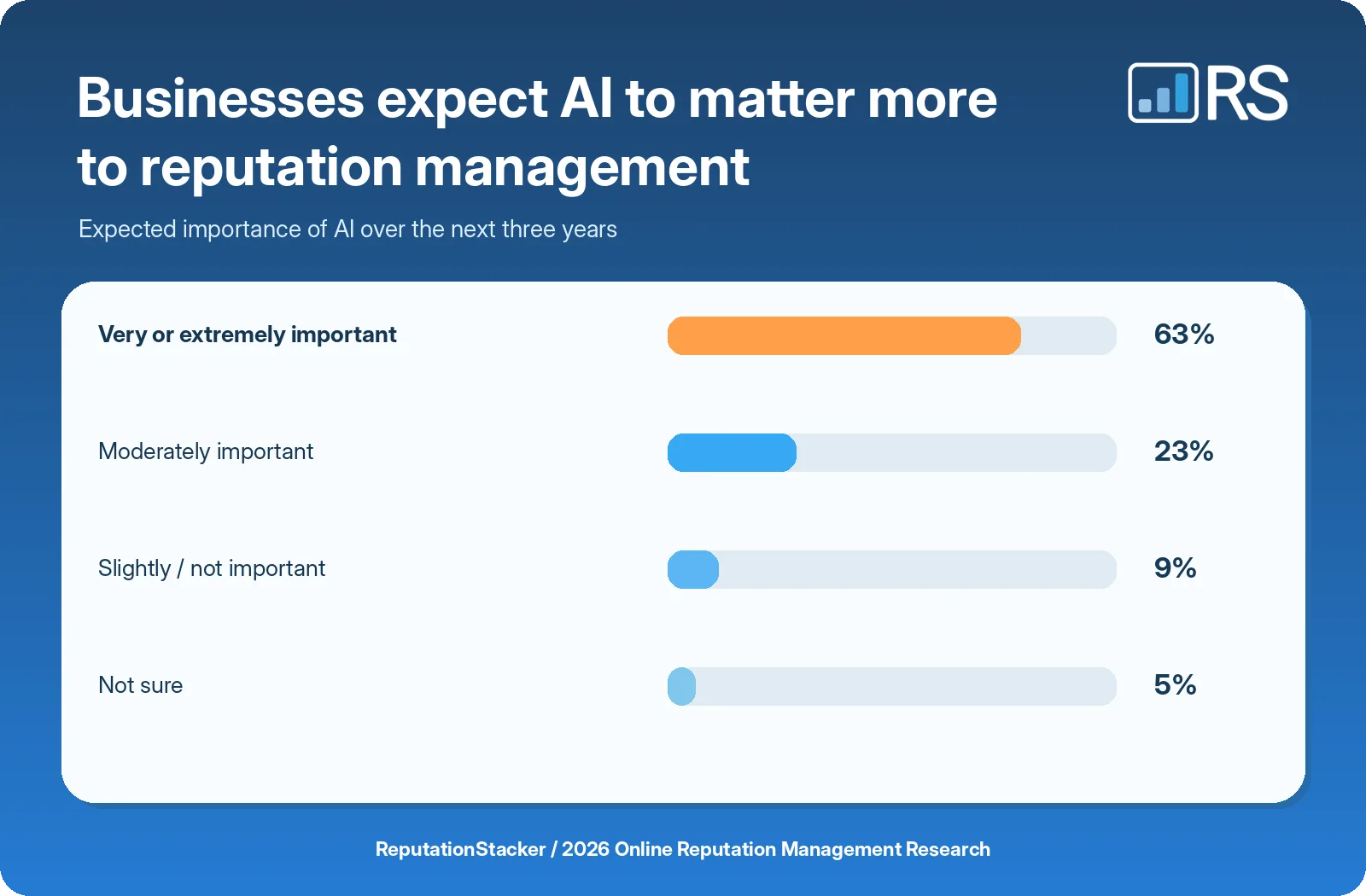
63% expect AI to become very or extremely important to reputation management within three years; another 23% expect moderate importance.
There is also a different AI problem on the horizon. 45% had never checked whether their business appeared in AI-generated business recommendations. Many businesses watch their Google reviews closely but have no idea what an AI assistant says when a prospective customer asks for a recommendation.
It’s worth looking at those answers periodically, especially when reputation and local discovery are central to the business. But one response from one chatbot is no substitute for tracking the bigger picture.
What to look for in AI reputation management software
We’d ask a vendor to demonstrate two different things. First, can it produce a sensible response to a specific negative review without resorting to canned compliments and apologies? Second, can it analyze a collection of reviews and answer a meaningful question about recurring customer problems?
If the software can do both, the next questions are about review approval, accuracy, privacy, and how it fits into the work your team already does.
Alongside its AI tools, ReputationStacker provides review monitoring and Location Review Analytics. That puts AI in the context of the broader reputation management program, where it can assist with everyday review work and uncover information managers can actually use.
Conclusion: AI has to earn its place in the workflow
The survey shows an active market for AI, but also one that’s still learning which tasks deserve automation and where people want the final say.
A business can save a few hours writing replies and call that a win. The larger opportunity is finding a repeat complaint before it becomes an accepted part of how the business operates.
ReputationStacker brings AI review replies and AI Review Insights together with the rest of its reputation management platform. Both have their place. We’d put particular weight on whether the analysis helps someone make a better decision.
Related ReputationStacker research
- 2026 State of Online Reputation Management & Customer Experience
- Customer Feedback Analysis: 2026 Research & Trends
- Multi-Location Reputation Management: 2026 Research & Trends
About the research
This ReputationStacker 2026 study includes 419 survey records, including partial responses, from business owners, managers, and others involved in online reputation management and customer experience. Respondents included current and former ReputationStacker users and other businesses. Results describe self-reported practices among those who answered each question and are not representative of all businesses. Some AI questions were shown only to respondents using particular AI capabilities.
